
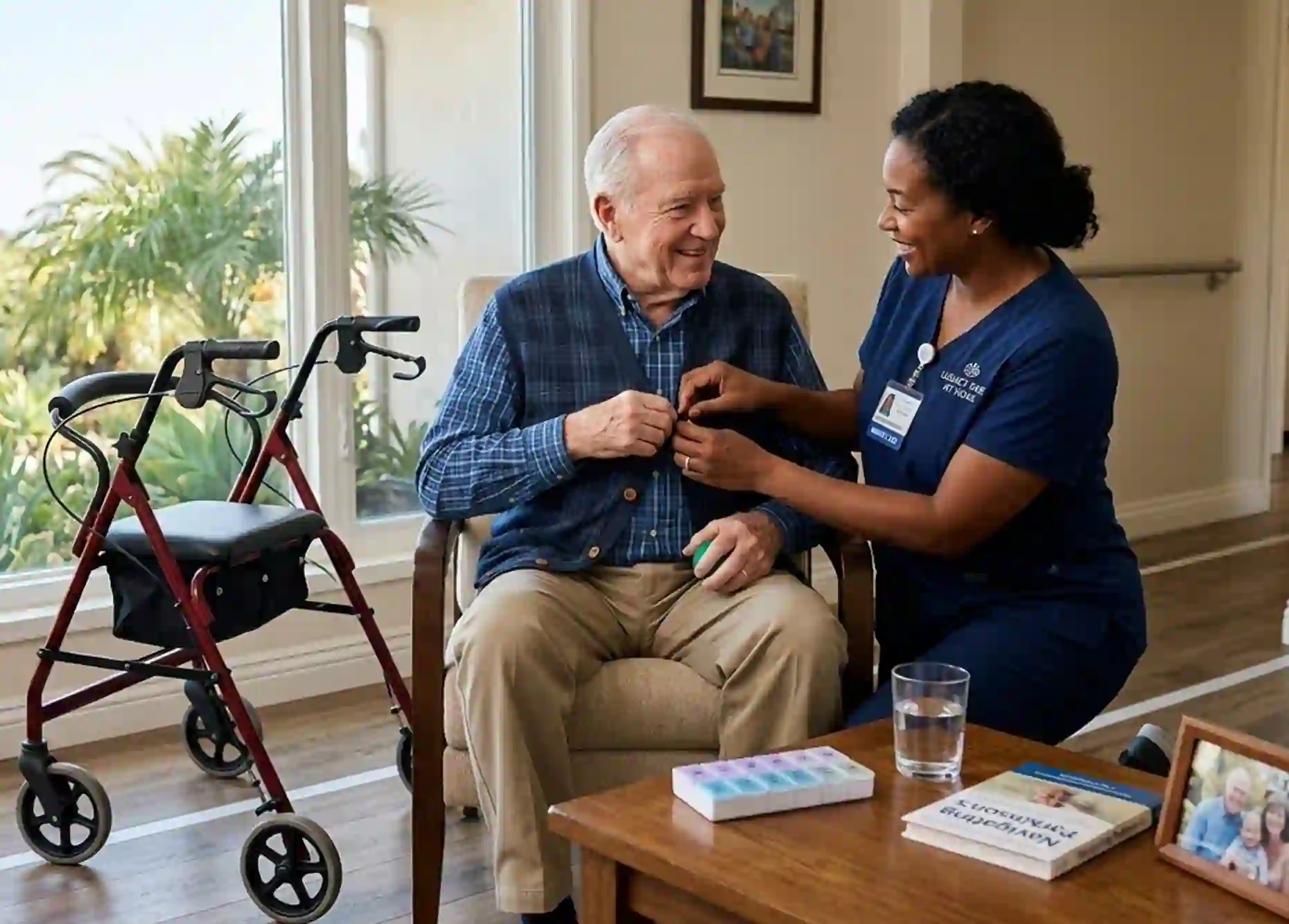
Managing a movement disorder like Parkinson’s disease (PD) is a journey that requires a specialized, proactive, and compassionate approach to care. For many families in the San Diego area, the priority is maintaining independence and quality of life within the familiar comfort of home.
As a nurse-led agency, we understand that “care” is not just about assisting with daily tasks—it is about clinical expertise, safety management, and emotional support for both the patient and their family. This comprehensive guide explores the essential components of in-home care for Parkinson’s and other movement disorders, incorporating the latest evidence-based strategies for 2026 (How to Introduce a Caregiver Without Conflict.)
1. Understanding the Complexity of Movement Disorders
Movement disorders encompass a range of neurological conditions that affect the speed, fluency, and ease of physical movement. While Parkinson’s is the most common, other conditions like Essential Tremor, Dystonia, and Progressive Supranuclear Palsy (PSP) require similarly nuanced care (Bautista, n.d.).
Common symptoms include:
- Tremors: Involuntary shaking, often at rest.
- Bradykinesia: Slowness of movement, making simple tasks like buttoning a shirt difficult.
- Rigidity: Stiffness in the limbs or trunk.
- Postural Instability: Impaired balance and coordination, significantly increasing fall risks.
2. The Nurse-Led Care Advantage of In-Home Care for Parkinson’s Disorder
Specialized nursing oversight is the gold standard for managing complex neurodegenerative conditions at home. Research indicates that nurse-led management significantly improves the handling of non-motor symptoms like sleep disorders, dysphagia (swallowing difficulties), and anxiety (Fujita et al., 2024).
Medication Management
Parkinson’s treatment often involves complex medication regimens, such as Carbidopa-Levodopa, which must be taken at precise intervals to minimize “off” periods. (Learn about Medication Management.) Nurses provide essential education to care staff and families to ensure these schedules are strictly maintained, preventing the sudden loss of mobility (Fujita et al., 2024).
Symptom-Specific Interventions
Innovative nursing protocols now address often-overlooked symptoms like sialorrhea (excessive drooling). Structured programs based on the Theory of Symptom Management (SMT) empower patients to modify behaviors like swallowing frequency and posture, reducing social embarrassment and improving self-esteem (Guan, 2026).
3. Creating a Safe Home Environment
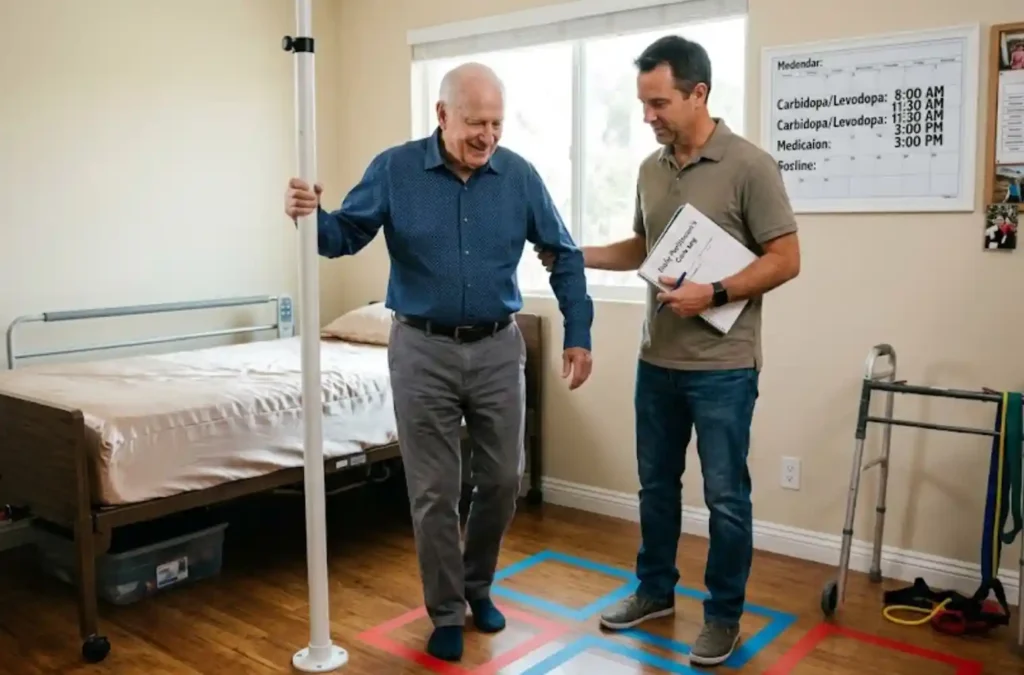
Safety is the foundation of in-home care. Because Parkinson’s affects balance and can cause “freezing of gait,” a home safety assessment is a critical first step.
High-Impact Home Modifications
- Lighting: Increase brightness in hallways and bathrooms to reduce “visual freezing” triggers.
- Flooring: Remove throw rugs and secure electrical cords. Consider high-contrast tape on floors to help guide movement during freezing episodes.
- Bathroom Safety: Install grab bars and raised toilet seats. A walk-in shower with a sturdy bench is often necessary as the disease progresses.
Multidisciplinary Safety Teams
Effective safety management involves a team including neurologists, specialized nurses, and physical therapists (Ding, 2026). This team can dynamically adjust care plans based on tools like the Berg Balance Scale, which helps measure a patient’s risk of falling (Donoghue & Stokes, 2009).
4. Evidence-Based Lifestyle Strategies of In-Home Care for Parkinson’s Disorder
Beyond medical treatment, lifestyle interventions play a significant role in slowing the progression of motor symptoms.
The Power of Aerobic Exercise
Engaging in regular aerobic exercise (maintaining 60%–85% of maximum heart rate) has been shown to stabilize motor symptoms and may even protect the integrity of the basal ganglia network in the brain (Janssen Daalen, 2025).
Recommended Exercise Methods:
- Tai Chi and Yoga: Excellent for balance and flexibility (Guan, 2026).
- Slow Walking and “Square Dancing”: Promotes rhythmic movement and social engagement (Guan, 2026).
- Gamification: Digital technology now allows for exercise programs in the home environment, increasing long-term compliance (Janssen Daalen, 2025).
Nutrition and Brain Health
Dietary patterns, such as the Mediterranean diet (high in vegetables, fruits, and unsaturated fats), are associated with neuroprotective benefits (Janssen Daalen, 2025). Some studies also suggest that moderate caffeine intake may have protective properties (Janssen Daalen, 2025).
5. Supporting the “Sandwich Generation” and Spousal Caregivers
Movement disorders don’t just affect the patient; they impact the entire family. Spousal caregivers often face a “multifactorial burden,” leading to exhaustion and a reduced quality of life (Klietz, 2022).
Navigating Neurobehavioral Changes
One of the most challenging aspects of late-stage Parkinson’s is the potential for delusions or hallucinations. These can range from suspecting intruders to delusions of infidelity, which can be uniquely threatening to marital relationships (Deutsch et al., 2021).
Professional in-home care provides a “respite” that is essential for preventing caregiver burnout. Having a trained professional handle the daily logistics allows family members to return to their primary roles as spouses and children.
6. Why San Diego Families Choose Legacy Care for In-Home Care for Parkinson’s Disorder
As a local, nurse-owned agency, we provide an exclusive level of care tailored to the San Diego lifestyle. Our approach integrates clinical expertise with a deep understanding of the emotional journey families are on.
- Nurse-Designed Care Plans: Every plan is overseen by a registered nurse with expertise in movement disorders.
- Specialized Caregiver Training: Our team is trained in specific techniques for Parkinson’s, including mobility assistance and medication timing.
- Local Expertise: We are deeply connected to the San Diego medical community, ensuring seamless coordination with your existing specialists.
Conclusion
In-home care for Parkinson’s is a dynamic process that must evolve as the condition changes. By combining expert nursing oversight, strategic home modifications, and evidence-based lifestyle choices, it is possible to live well with a movement disorder.
Ready to discuss a personalized care plan? Contact us today to learn how our nurse-led team can support your family.
References
Bautista, C. (n.d.). Evidence-based strategies for care of the patient with movement disorders and deep brain stimulation. American Association of Neuroscience Nurses. https://aann.org/uploads/Publications/CPGs/AANN19_CPG_Movement_Disorders_final.pdf
Cited by: 1
Deutsch, C. J., Robertson, N., & Miyasaki, J. M. (2021). Psychological impact of Parkinson disease delusions on spouse caregivers: A qualitative study. Brain Sciences, 11(7), 871. https://doi.org/10.3390/brainsci11070871
Cited by: 10
Ding, Y. (2026). Summary of the best evidence for safety management in patients with Parkinson’s disease accompanied by behavioral and psychiatric symptoms: A systematic review. PMC. https://pmc.ncbi.nlm.nih.gov/articles/PMC12983160/
Donoghue, D., & Stokes, E. K. (2009). How much change is true change? The minimum detectable change of the Berg Balance Scale in elderly people. Journal of Rehabilitation Medicine, 41, 343-346. https://doi.org/10.2340/16501977-0337
Cited by: 553
Fujita, T., Iwaki, M., & Hatono, Y. (2024). The role of nurses for patients with Parkinson’s disease at home: a scoping review. BMC Nursing, 23. https://doi.org/10.1186/s12912-024-01931-y
Cited by: 14
Guan, H. (2026). Nurse-led management of sialorrhea in Parkinson’s disease: a pilot randomized controlled trial. Frontiers in Medicine. https://www.frontiersin.org/journals/medicine/articles/10.3389/fmed.2026.1788173/full
Janssen Daalen, J. M. (2025). Lifestyle interventions for the prevention of Parkinson disease. Neurology.
Cited by: 71
Klietz, M. (2022). Caregiver burden in movement disorders and neurodegenerative diseases: Editorial. Brain Sciences, 12(9), 1184. https://doi.org/10.3390/brainsci12091184
Cited by: 18
Pingback: How to Prevent Falls at Home: A Room-by-Room Senior Safety Checklist - Legacy Care