
When an aging parent or loved one encounters a health crisis, a fall, or a new medical diagnosis, family members quickly scramble to arrange support. During this research process, two terms appear constantly: Home Health and Home Care.
To the average person, these phrases sound identical. However, in the state of California, they represent entirely different types of care, fall under completely separate state regulations, require different staff qualifications, and use vastly different payment methods.
Confusing these two services is one of the most common mistakes California families make. It leads to immense frustration, delayed care, and unexpected out-of-pocket bills.
This comprehensive guide breaks down the core distinctions between Home Health and Home Care in California, helping you identify exactly what your family needs and how to navigate the complex landscape of eldercare options.
The Core Difference: Clinical Medical Treatment vs. Daily Lifestyle Support
The easiest way to understand the difference between the two fields comes down to a simple formula: Home Health is clinical, medical care. Home Care is non-medical, personal care and lifestyle support.
What is Home Health Care?
Home Health is short-term, intermittent medical care prescribed directly by a licensed physician. It is designed to treat, manage, or monitor a specific medical condition, illness, or acute injury.
The primary goal of Home Health is rehabilitation or stabilization. It helps an individual regain independence after a hospital discharge, a stroke, or a major surgery (like a total hip or knee replacement). Because it involves clinical tasks, it must be delivered by licensed medical professionals.
What is Home Care?
Home Care (often called private duty home care, personal care, or companion care) covers non-medical assistance. It focuses on helping seniors complete everyday tasks so they can remain living safely and comfortably in their own homes.
Instead of medical treatment, Home Care centers on assistance with Activities of Daily Living (ADLs) and companionship. This service is generally continuous, long-term, and structured around a family’s ongoing schedule. (Learn about long-term care planning)
Detailed Comparison Breakdown
To help evaluate your options at a glance, this table compares how these services operate across California:
| Feature | Home Health Care | In-Home Care |
| Primary Goal | Medical rehabilitation, wound healing, and disease stabilization. | Safe aging in place, companionship, and daily task assistance. |
| Type of Care | Clinical, medical, and skilled nursing. | Non-medical, personal care, and lifestyle management. |
| Staff Credentials | Registered Nurses (RNs), Licensed Vocational Nurses (LVNs), Physical Therapists (PTs), Occupational Therapists (OTs). | Home Care Aides (HCAs), professional caregivers, companion sitters. |
| Doctor’s Order Required? | Yes. Cannot begin without a physician’s signature and official care plan. | No. Families can self-refer and hire services whenever they choose. |
| Duration of Visits | Short visits (typically 45 to 60 minutes per session), a few days a week. | Block shifts (ranging from 4 hours minimum up to 24-hour live-in care). |
| California Regulation | California Department of Public Health (CDPH). | California Department of Social Services (CDSS) Home Care Bureau. |
| Primary Funding Sources | Medicare, Medi-Cal, private health insurance. | Long-Term Care Insurance, VA Aid and Attendance, private family pay. |
Deep Dive: Understanding Home Health Care in California
To qualify for Home Health services under California regulations, specific criteria must be met before a clinical provider can accept a case.
Who Performs the Care?
Home Health care is provided by a multidisciplinary medical team. Depending on a patient’s specific needs, visits may involve:
- Registered Nurses (RNs) or Licensed Vocational Nurses (LVNs): Manage clinical needs like administering intravenous (IV) medications, changing surgical dressings, managing complex pill regimens, or maintaining catheters.
- Physical Therapists (PTs): Build strength, restore balance, and re-train gait mechanics after a severe fall, joint replacement, or stroke.
- Occupational Therapists (OTs): Assist seniors in re-learning how to perform daily routines using adaptive tools, modifying the home environment to match new physical limits.
- Speech-Language Pathologists (SLPs): Treat swallowing disorders (dysphagia) or speech difficulties stemming from neurological events.
Strict “Homebound” Requirements
For government programs like Medicare to cover Home Health, the patient must meet the strict federal definition of being homebound. (Learn about what Medicare covers.)
This does not mean the individual is completely unable to leave the house. Rather, it means that leaving the home requires an enormous, taxing physical effort and typically demands the assistance of another person or specialized mobility gear (like a wheelchair or walker). Leaving the home must be infrequent and brief, such as attending a medical appointment or a unique religious service.
Typical Home Health Timelines
Home Health is rarely a long-term solution. It is ordered in specific 60-day certification windows. A nurse or therapist will visit the home for roughly an hour, two to three times a week.
Once the patient reaches their rehabilitation goals, stabilizes, or no longer meets the homebound criteria, the physician will officially discharge them from Home Health services.
Deep Dive: Understanding In-Home Care in California
Unlike the clinical restrictions of Home Health, Home Care is flexible, customizable, and designed to support a senior’s lifestyle over months or years.
What Does a Caregiver Do?
Because home care aides are non-medical, they do not administer injections, change sterile wound dressings, or adjust medical dosages. Instead, they focus on two main areas: Activities of Daily Living (ADLs) and Instrumental Activities of Daily Living (IADLs).
Caregiver duties typically include:
- Personal Hygiene Support: Safely assisting with showering, preventing slips on slick bathroom tiles, as well as grooming and dressing.
- Incontinence Care: Discreetly assisting with toileting needs and maintaining skin integrity.
- Meal Preparation: Cooking nutritious meals tailored to dietary guidelines, and cleaning up afterward.
- Light Housekeeping: Managing laundry, changing bed linens, vacuuming, and keeping walkways clear of trip hazards.
- Medication Reminders: Helping seniors remember to take pre-poured medications on schedule (without physically managing or pouring the prescriptions).
- Transportation & Errands: Driving to doctor appointments, picking up prescriptions from local pharmacies, and grocery shopping.
California’s Home Care Services Consumer Protection Act
In California, the private home care industry is strictly regulated under the Home Care Services Consumer Protection Act, managed by the California Department of Social Services (CDSS).
By law, any reputable California home care agency must ensure their caregivers are officially registered on the state’s Home Care Aide Registry. This registration requires passing a rigorous live-scan criminal background check through both the Department of Justice (DOJ) and the Federal Bureau of Investigation (FBI). Agencies must also ensure their staff are fully bonded, insured, and tested for tuberculosis (TB). [10 Questions You Must Ask When Interviewing In-Home Care Agencies in San Diego]
Financial Differences: Who Pays for What?
The financial framework highlights why families must understand these distinctions clearly. Misunderstanding the service can result in immense financial strain.
How Home Health is Covered
Because Home Health is recognized as essential medical care, it is heavily covered by insurance providers if eligibility requirements are satisfied:
- Medicare: Covers 100% of approved Home Health services for eligible individuals, provided the care is ordered by a participating doctor and delivered by an approved Medicare-certified Home Health Agency (CHHA). There is typically zero co-pay for these clinical visits.
- Medi-Cal: California’s Medicaid program covers necessary medical home health visits for low-income beneficiaries.
- Private Health Insurance / Blue Cross / Kaiser: Commercial policies generally cover skilled home health care after surgeries or acute illnesses, subject to standard plan deductibles and network definitions.
Critical Warning: Medicare and standard health insurance policies do not pay for long-term, hourly, non-medical Home Care. Medicare will not pay for a caregiver to sit with an aging parent for 8 hours a day to cook, tidy up, or provide companionship.
How Home Care is Funded
Because Home Care is labeled non-medical lifestyle support, it is predominantly funded through private means or niche insurance structures:
- Private Pay (Out-of-Pocket): The majority of families fund private-duty home care out of personal savings, retirement accounts, or by leveraging home equity.
- Long-Term Care Insurance (LTCI): Private insurance policies explicitly designed to cover long-term care needs will pay for non-medical home care, provided the senior meets the policy’s specific “benefit triggers” (usually requiring assistance with at least two distinct Activities of Daily Living).
- VA Aid and Attendance Benefit: As an enhanced pension program, this benefit provides a tax-free monthly stipend to wartime veterans and surviving spouses to directly offset the costs of hiring private-duty caregiving agencies.
- Medi-Cal waivers (HCBS): Certain specialized California Medicaid waiver programs, such as the Assisted Living Waiver (ALW) or Home and Community-Based Services (HCBS), offer limited hours of non-medical caregiving for eligible individuals, though waiting lists are common. [Read this guide about Home Care vs. Assisted Living for Your Aging Parent]
The Ultimate Hybrid Approach: How Both Services Work Together
Choosing between these two services isn’t always necessary. In fact, when a senior is recovering from a major health event, Home Health and Home Care work best when deployed at the exact same time.
Consider this common scenario: An 82-year-old grandfather suffers a stroke and is discharged from a rehabilitation hospital back home.
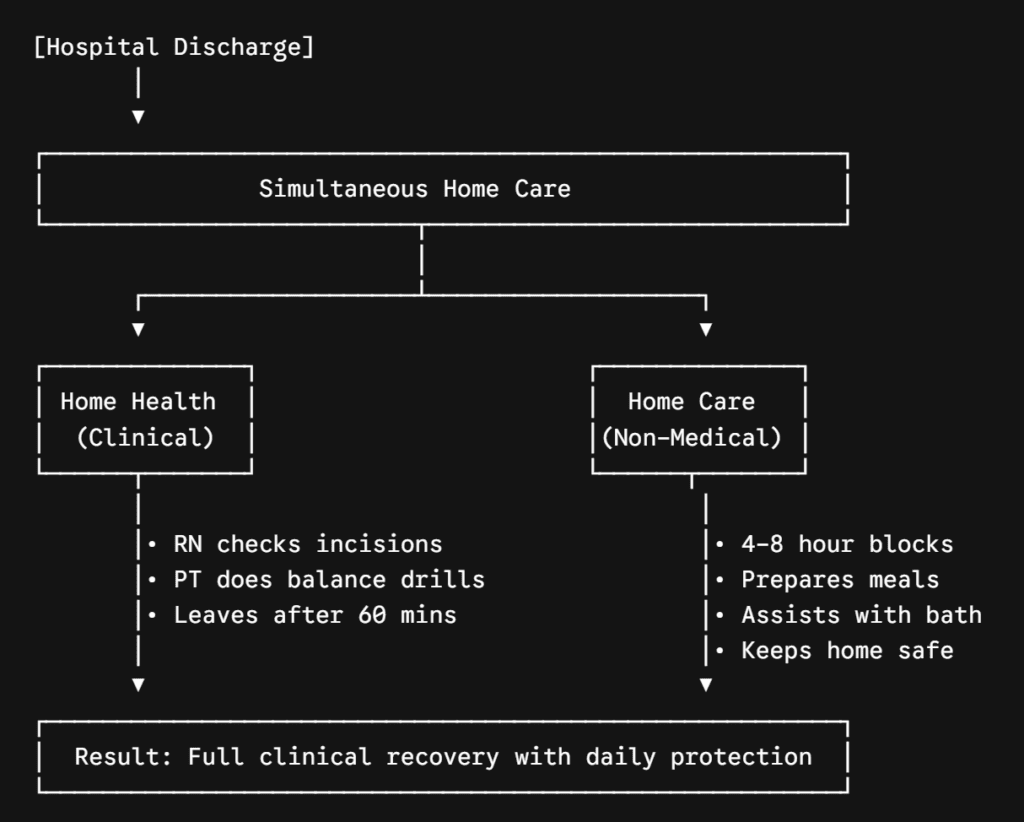
By coordinating both teams, the senior receives necessary clinical oversight to heal properly alongside continuous personal care to ensure safety throughout the day.
How to Determine Which Service Your Family Needs Now
If you are trying to decide which agency type to call today, step back and evaluate your loved one’s primary challenges.
Choose Home Health If:
- They recently underwent a major surgery or hospital stay and require professional monitoring during recovery.
- They have a new surgical wound that needs sterile dressing changes.
- They need intensive, short-term physical or occupational therapy to regain mobility.
- A doctor needs to closely track a fluctuating medical condition or adjust complex intravenous prescriptions.
Choose Home Care If:
- They are physically fragile, unsteadily navigating hallways, and are at a high risk for dangerous falls.
- Advanced cognitive decline, Alzheimer’s, or dementia makes it unsafe for them to be left home alone.
- They are neglecting personal hygiene, skipping meals, or forgetting to take their daily medications.
- They no longer drive safely and need reliable transport to medical visits or grocery stores.
- They require assistance with everyday tasks like laundry, light housekeeping, and cooking.
Finding Certified Care in California
When you are ready to reach out to providers, make sure you approach agencies with the right questions based on the type of care you need.
If you require Home Health, ask your primary physician or hospital discharge planner for a referral to a trusted, Medicare-certified agency in your local area.
If you require Home Care, ensure you interview state-licensed Home Care Organizations (HCOs). Always confirm that their staff are registered, fully background-checked employees rather than independent contractors, ensuring your family receives the highest standard of protection under California law.