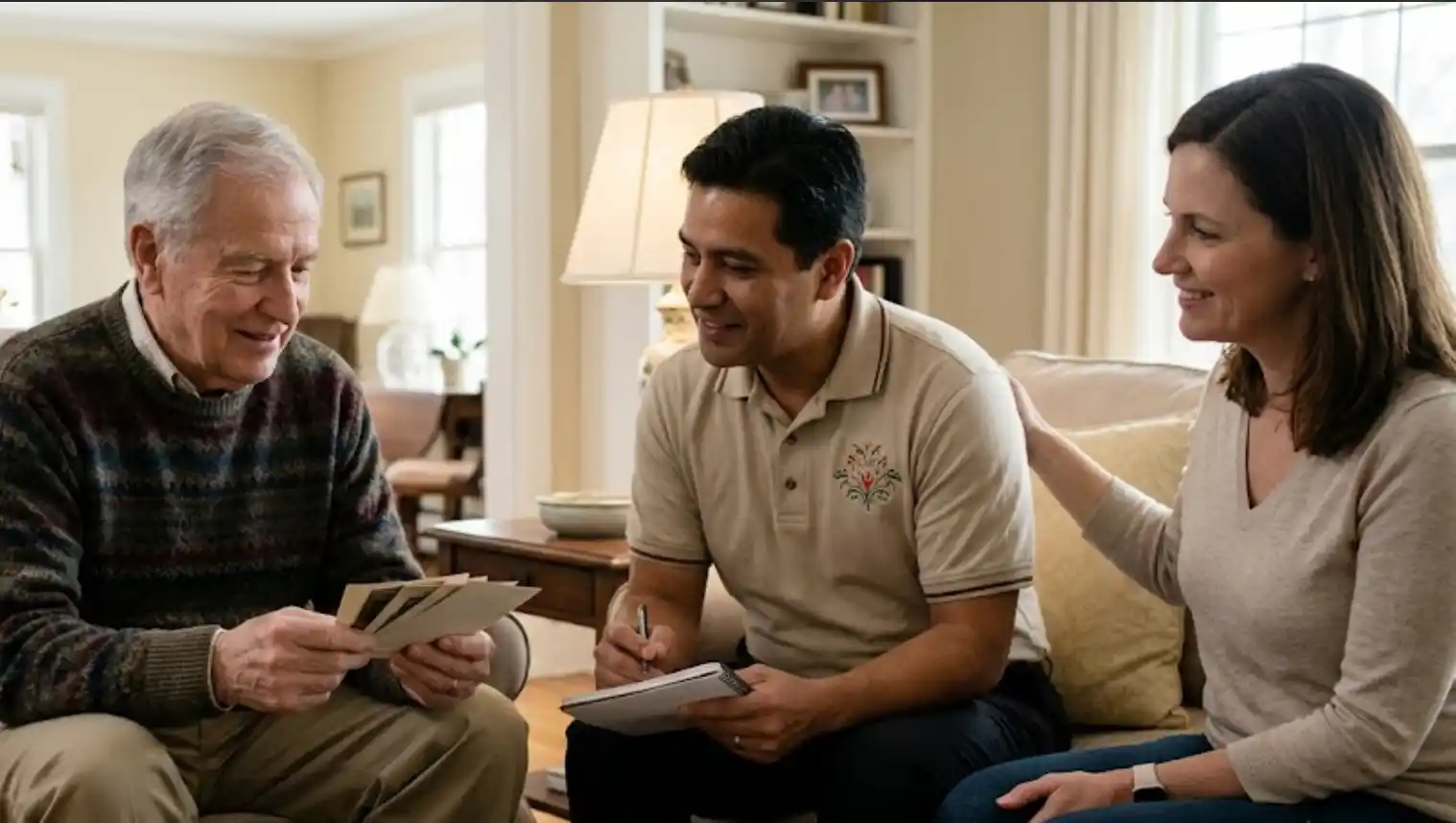
It is a scenario playing out in thousands of households across California every single day. You notice the signs during a weekend visit: the refrigerator is filled with expired food, a dent on the car bumper goes unexplained, prescription bottles are scattered haphazardly on the counter, or your normally immaculate mother is wearing the same stained blouse for three days straight.
Deep down, you know they are no longer safe living entirely alone. But the moment you gently suggest bringing in a professional helper, you are met with a wall of fierce resistance.
“I don’t need a stranger in my house.”
“I’ve taken care of myself for eighty years, and I don’t need a babysitter now.”
“If you try to force someone in here, I simply won’t let them through the front door.”
Hearing your aging parents refuse help can stir up a painful mix of anxiety, frustration, and fear. You worry constantly about a catastrophic fall or a missed medication dose, yet you feel completely powerless to intervene without starting a massive family conflict.
This comprehensive guide explores the deep psychological reasons behind eldercare resistance and provides a step-by-step, conflict-free framework to successfully introduce an in-home caregiver while preserving your parents’ dignity, autonomy, and peace of mind.
1. The Psychology of Resistance: Why Seniors Refuse Help
Before you can change your approach, you must understand what your parents are truly feeling. Resistance to care is rarely driven by simple stubbornness. Instead, it is a deeply rooted defense mechanism against a series of profound, scary lifecycle changes.
The Threat to Autonomy and Independence
For an adult who has spent decades running a household, building a career, raising children, and making independent choices, admitting the need for help feels like an admission of defeat. Accepting a caregiver can feel like the final step before losing their independence entirely or being forced into an assisted living facility. When they say “no” to a caregiver, they are often trying to maintain control over an environment that feels increasingly unstable. [Read this guide about Home Care vs. Assisted Living for Your Aging Parent]
Fear of Loss and Aging
As individuals age, their world naturally shrinks. They may experience the loss of lifelong friends, declining physical mobility, fading eyesight, or slipping cognitive clarity. Their home is their ultimate sanctuary—the one place where they still feel secure. Bringing an outside professional into that private space forces them to confront the reality of their own physical or mental decline, which can trigger intense grief and vulnerability.
Privacy Concerns and Vulnerability
Allowing an unfamiliar face into the home is an invasive experience. It means letting a stranger see their physical frailties, watch them struggle to stand up from a low chair, or assist them with deeply personal tasks like showering or using the restroom. For a intensely private senior, this level of vulnerability can feel overwhelming and embarrassing.
Cognitive Changes and Anosognosia
In many situations involving neurodegenerative conditions like Alzheimer’s disease or vascular dementia, resistance stems from a clinical condition known as anosognosia. This is a neurological deficit that leaves a person genuinely unable to perceive their own impairments.
[Brain Pathology / Dementia] ──► [Anosognosia (Lack of Insight)] ──► "I am perfectly fine."
                                                                               │
                                                                               ▼
                                                                     [Perceived Threat]
                                                               "Why is this stranger here?"
When a parent with anosognosia insists they can drive safely or manage their own pills perfectly, they are not lying or being intentionally difficult. Their brain is simply no longer processing their functional limitations. To them, your offer of help seems entirely unnecessary and intrusive, which naturally sparks a defensive reaction.
2. Words Matter: Shifting Your Communication Strategy
When addressing care needs, the specific phrases you choose can either build an open bridge of communication or slam the door shut. Standard logic—like listing safety risks or pointing out mistakes—often backfires by making seniors feel judged and defensive.
Avoid High-Trigger Words
Certain words immediately trigger mental images of dependency, institutionalization, and disability. Erase these terms from your vocabulary when speaking with your parents:
- ~~”Caregiver”~~
- ~~”Home Care Aide”~~
- ~~”Assistance”~~
- ~~”Babysitter”~~
- ~~”Supervision”~~
Embrace Empowering Alternatives
Frame the service around luxury, lifestyle optimization, home maintenance, or administrative support. This positions the helper as an asset that supports their lifestyle rather than an accommodation for disability:
- “Personal Assistant”
- “Executive Housekeeper”
- “Private Driver / Companion”
- “Home Organizer”
- “Concierge Care”
The Art of Non-Confrontational Scripting
Instead of using “You” statements that sound critical, shift the focus to your own feelings by using “I” statements. Frame the arrangement as a favor to you rather than a requirement for them.
| What Not to Say (Accusatory) | What to Say Instead (Empowering / Favor-Based) |
| “You aren’t cooking healthy meals anymore, and you’re losing too much weight.” | “I worry so much about you getting delicious, home-cooked meals during the week. I’d love to hire a personal chef to prep some dishes for you.” |
| “You almost fell in the shower last week. You aren’t safe living alone anymore.” | “I find myself constantly worrying about the house when I’m at work, and it’s making it hard for me to focus. Having a helper around a few days a week would give me immense peace of mind.” |
| “You can’t drive safely anymore, so I’m bringing someone in to take over.” | “Traffic in town has gotten so chaotic lately. I’ve retained a personal driver for a few hours a week so you can run your errands comfortably without dealing with parking stress.” |
3. The “Foot-in-the-Door” Technique: A Gradual Introduction
Trying to introduce a full-time, 24-hour caregiver right away is a recipe for conflict. The most successful transitions use a gradual, multi-layered approach that allows your parent to get comfortable with the concept of outside help over time.
[Phase 1: Specialized Project] ──► [Phase 2: Part-Time Support] ──► [Phase 3: Comprehensive Care]
     - Deep house cleaning             - 4 hours, 2 days a week          - ADL & personal care
     - Technology setup                - Focus on companionship          - Fully integrated routine
Phase 1: Begin with a Neutral, Non-Care Project
Introduce an outside helper to tackle a specific, non-medical household project that does not threaten your parent’s identity.
- Hire a professional organizer to help clean out the garage or organize old photo albums.
- Bring in an “executive housekeeper” for a thorough, deep cleaning of the kitchen and bathrooms.
- Introduce a tech-savvy student or companion to help them set up a new tablet or learn how to video call family members living out of state.
During this phase, the helper is simply working alongside your parent on a concrete task. This gives your parent a chance to realize that having someone else in the house can be a pleasant, low-stress experience.
Phase 2: Start with Minimal, Part-Time Hours
Once your parent accepts a helper’s presence, introduce a part-time schedule through a professional home care agency. [10 Questions You Must Ask When Interviewing In-Home Care Agencies in San Diego]. Start with just 4 hours a day, two days a week.
Frame these initial shifts around low-stakes activities:
- Going out to a favorite local nursery to look at plants.
- Driving to a grocery store or running errands together.
- Preparing a fresh lunch and playing a game of cards.
Keep the primary focus entirely on companionship and light lifestyle support. Do not have the helper manage personal hygiene, bathing, or medication monitoring during these first few weeks unless it is absolutely necessary for basic safety.
Phase 3: Gradually Shift Toward Personal Care
As your parent builds a genuine bond with the companion, you can slowly expand their responsibilities. Because a foundation of trust has been built, your parent will be significantly more receptive when that specific person offers a hand climbing out of the shower, assists with daily dressing, or reminds them it’s time to take their pills.
4. Validated Strategies to Bypass Direct Conflict
If your parent remains completely resistant despite a gradual introduction, you may need to use advanced strategies that shift the decision-making authority away from you.
Strategy 1: The “Doctor’s Prescription” Strategy
Seniors who routinely reject advice from their adult children will often defer to the absolute authority of a medical professional. Schedule a private consultation with your parent’s primary physician or specialist before their next regular check-up. Explain your specific safety concerns and request that the doctor deliver the directive.
When the doctor writes down on a prescription pad: “In-home companion required 3 days per week for mobility safety,” you are no longer the “bossy” child forcing an unwanted choice. You are simply the supportive son or daughter helping them comply with their doctor’s official medical orders.
Strategy 2: The Trial Period Compromise
If your parent is completely locked in a standoff, avoid arguing. Instead, propose a short-term, limited trial period.
“Mom, let’s just try having Sarah come over for a total of two weeks. If you still absolutely detest the arrangement after fourteen days, we can stop and look for a different solution. Let’s just treat this as a temporary experiment.”
Most seniors can tolerate an uncomfortable idea if they know it has a definitive end date. In the vast majority of cases, once the trial period concludes, the senior has bonded with the caregiver, adjusted to the new routine, and will quietly allow the schedule to continue without further argument.
Strategy 3: Blame an External Entity
If your parents are worried about money or feel you are spending too much on their care, shift the financial responsibility to an external benefit.
- If they are wartime veterans, frame the care provider as a mandatory component required to unlock their tax-free VA Aid and Attendance pension benefits.
- If they have a Long-Term Care Insurance policy, remind them that they have paid premiums for years, and the insurance company now requires an agency contract to unlock their payouts.
5. Choosing the Right Caregiver Personality Match
The success of a conflict-free introduction depends heavily on pairing your parent with the right caregiver personality match. When interviewing home care agencies, look beyond basic scheduling availability and focus closely on personal compatibility.
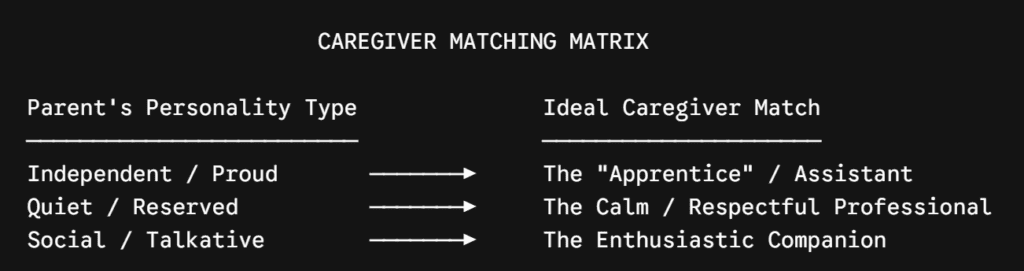
- The Proud, Independent Parent: Match them with a caregiver who can play the role of an “apprentice.” The caregiver can ask the senior for advice on cooking, gardening, or life experiences while gently handling the physical heavy lifting in the background. This keeps the senior feeling valued and in control.
- The Quiet, Introverted Parent: Pair them with a calm, gentle caregiver who respects personal boundaries, excels at non-intrusive support, and doesn’t overwhelm the home with constant conversation.
- The Social, Talkative Parent: Match them with an energetic, enthusiastic companion who loves listening to stories, looking through old photo albums, and taking walks together.
6. Managing the First Day: A Conflict-Free Action Plan
The first day a caregiver arrives at the house is the most critical hurdle. Proper preparation can prevent a last-minute refusal at the front door.
1.Be Personally Present:Step 1.
Never leave a new caregiver to show up on your parent’s doorstep alone. Plan to be physically present at the home at least 30 minutes before the caregiver arrives to keep the environment calm, relaxed, and reassuring.
2.Make a Warm, Personal Introduction:Step 2.
When the caregiver arrives, greet them warmly like an expected guest or a family friend. Introduce them using the alternative framing you chose: “Dad, this is Laura. She’s the home organization assistant we talked about who is going to help us manage the weekly meal prep and grocery runs.”
3.Facilitate an Initial Icebreaker:Step 3.
Directly guide the conversation toward a topic of mutual interest to break the ice. “Laura, my dad used to serve in the Navy and loves talking about classic ships. Dad, Laura’s grandfather was actually stationed down at the San Diego naval base too.”
4.Step Back and Create Space:Step 4.
Once an initial connection is made, excuse yourself from the room for a brief period to run a quick errand or step into the backyard. This forces your parent and the caregiver to interact directly, giving them a chance to build an independent rapport without relying on you to anchor the conversation.
7. When It’s An Emergency: Handling Immediate Safety Risks
While a gradual introduction is always the ideal path, certain crises leave you no time for slow transitions. If your parent is experiencing advanced dementia, wandering into the street, leaving burners active on the stove, or experiencing recurring falls, safety must take priority over avoiding conflict. [A Daily Routine for Seniors with Dementia: Reducing Anxiety and Sundowning]
In an urgent safety crisis:
- Prioritize Safety Clearances: Secure the home immediately with specialized tools like automatic stove shut-off valves, keyless deadbolts with hidden codes, and smart fall-detection cameras.
- Utilize Professional Interventionists: If family dynamics are completely broken and conversations consistently devolve into yelling matches, retain an independent Aging Life Care Professional (also known as a Private Geriatric Care Manager). These licensed professionals serve as objective, third-party experts who can step in to evaluate the home, deliver recommendations, and coordinate care, absorbing the emotional friction so you can focus entirely on being a supportive child.
Summary Action Checklist for Families
To successfully bring help into a resistant parent’s home without causing conflict, review this quick action checklist:
- Deconstruct Resistance: Determine if their refusal is driven by a fear of losing independence, privacy concerns, or clinical anosognosia.
- Audit Your Vocabulary: Remove high-trigger words like “caregiver” and replace them with empowering titles like “personal assistant” or “home organizer.”
- Use “I” Statements: Frame the care as a personal favor to reduce your own anxiety rather than a critique of their abilities.
- Start Small: Use the foot-in-the-door technique by introducing a helper for a simple, neutral home project first.
- Leverage Authority: If a standoff persists, enlist their primary doctor to write a formal “prescription” for home support.
- Propose an Experiment: Secure agreement for a limited, two-week trial period rather than a permanent lifestyle change.
- Interview for Compatibility: Prioritize a strong personality and interest match when selecting a professional care provider.