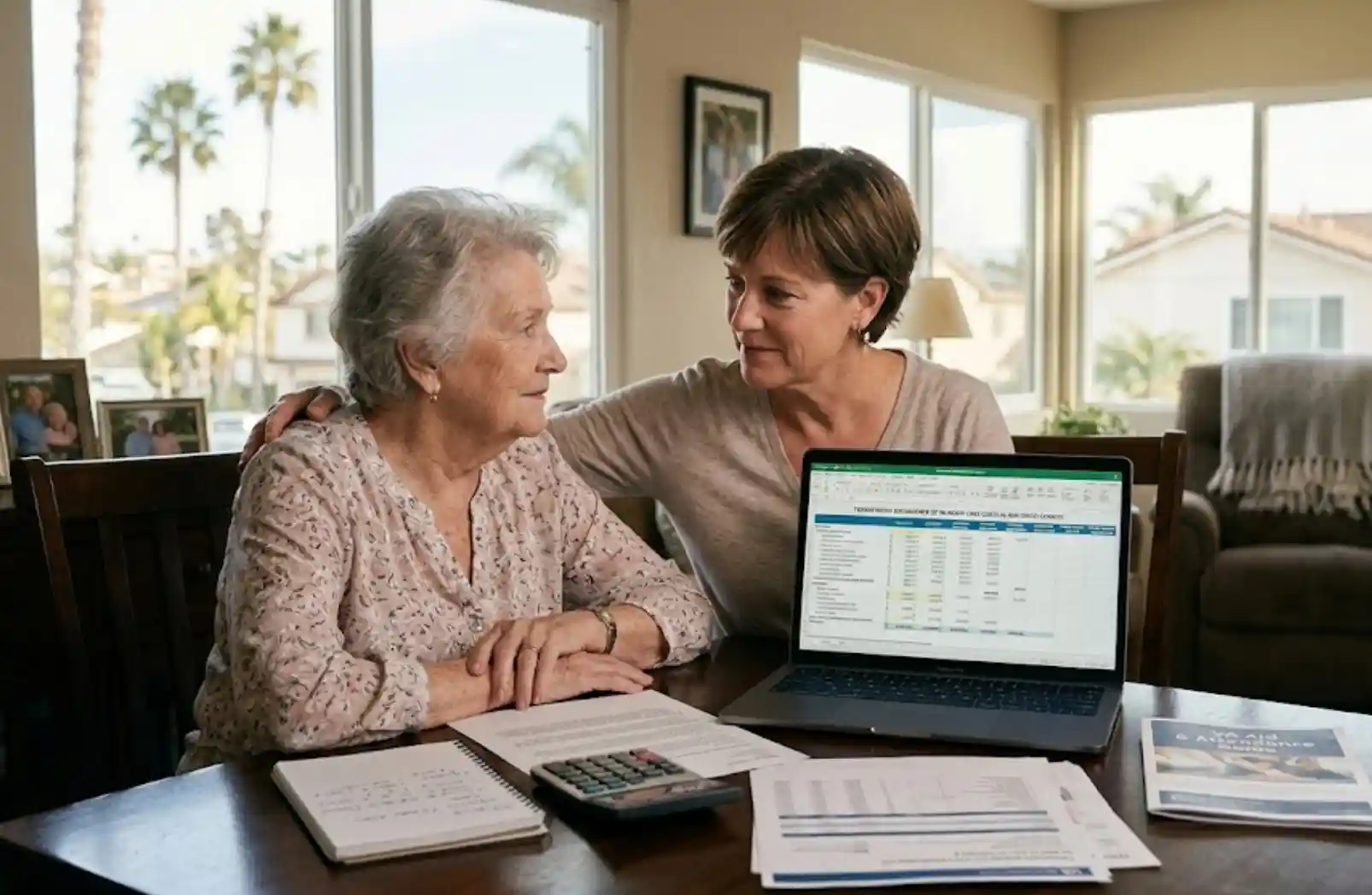
As the senior population in Southern California continues to grow, more families are exploring ways to help their elderly loved ones age in place safely. San Diego is a spectacular place to retire, but it is no secret that the region carries a high cost of living. When a family member begins to require assistance with daily activities, understanding the financial landscape of long-term care becomes an immediate priority.
This comprehensive guide delivers a completely transparent breakdown of the cost of in-home care across San Diego County. We will examine regional hourly rates, evaluate the true financial differences between hiring an agency versus an independent caregiver, look closely at hidden costs, and detail the strategic avenues available to fund this vital service.
1. Average Hourly and Monthly Care Rates in San Diego
In-home care is distinct from institutional care options like assisted living or nursing homes because it is almost exclusively billed by the hour. This variable structure means your overall expenditure depends entirely on the frequency, timing, and intensity of the shifts you schedule. [Read this guide about Home Care vs. Assisted Living for Your Aging Parent]
The Regional Benchmark
According to recent industry data from the comprehensive CareScout Cost of Care Survey, the median cost for agency-arranged, non-medical in-home care in California sits around $38.50 to $40.00 per hour. In San Diego proper, private-pay agency rates typically span a targeted planning range of $34.00 to $38.00+ per hour for standard daytime shifts, with some full-service agencies commanding $35.00 to $45.00 per hour depending on the complexity of care required.
This positions San Diego as one of the more expensive metropolitan areas for senior care in the United States, tracking roughly 15% above the national median.
Monthly Projections Based on Care Schedules
To give you a realistic idea of what your family might spend, let’s translate these hourly fees into common monthly care timelines. For these institutional projections, we will use a competitive local baseline agency rate of $36.00 per hour.
| Care Level & Weekly Schedule | Computational Formula | Estimated Monthly Expense |
| Part-Time / Respite Care (15 hours per week) | $15 hours x $36 x 4.33 weeks | $2,338 |
| Part-Time Daytime Support (20 hours per week) | $20 hours x $36 x 4.33 weeks | $3,117 |
| Full-Time Standard Daytime Care (40 hours per week) | $40 hours x $36 x 4.33 weeks | $6,235 |
| Extensive Support / Double Shifts (60 hours per week) | $60 hours x $36 x 4.33 weeks | $9,352 |
Note: The multiplier 4.33 represents the average number of weeks in a single calendar month, ensuring your budget accounts for partial weeks.
2. Micro-Markets: How Cost Shifts Across San Diego County
San Diego County covers over 4,000 square miles, and home care rates fluctuate noticeably depending on the specific neighborhood or municipality you live in. These price variations are driven by local cost-of-living differences, caregiver travel distances, and localized talent pools.
High-Cost Enclaves
Coastal and historically affluent communities generally demand the highest hourly premiums in the county. In areas like La Jolla, Del Mar, Coronado, and Rancho Santa Fe, starting rates for a licensed caregiver frequently range from $32.60 to over $40.00 per hour. Agencies operating in these micro-markets often encounter higher operating overhead and must offer top-tier compensation to attract skilled staff willing to commute.
Mid-Range and Inland Corridors
Central San Diego, along with the larger inland suburban cities, closely aligns with the county median. Areas such as Chula Vista, Mesa, Clairemont, and Escondido see average baseline starting rates hovering between $26.50 and $28.00 per hour for direct independent hires, with traditional full-service agency care scaling up to the $34.00–$37.00 range.
More Cost-Effective Regions
Families looking for slightly more accessible entry points often look to the East County or specific North County inland pockets. Communities like El Cajon, Spring Valley, and San Marcos feature some of the region’s lowest starting benchmarks, where independent caregiver rates can begin anywhere from $22.33 to $24.88 per hour.
3. Agency vs. Independent Caregivers: The Real Financial Comparison
When a family realizes that care is necessary, they face a critical structural decision: do they contract an established Home Care Organization (HCO) licensed by the state of California, or do they hire an independent private caregiver directly from an online registry or job board?
While independent hires feature lower upfront hourly rates on paper, they shift a significant array of legal and financial responsibilities onto the family.
Traditional Licensed Home Care Agencies
- Hourly Cost Range: $34.00 – $45.00 per hour
- What is Included in the Premium: The agency acts as the legal employer of record. Their hourly rate covers all mandatory federal and California payroll taxes, worker’s compensation insurance, general professional liability insurance, and extensive background checks.
- Operational Protection: If a scheduled caregiver falls ill or experiences an emergency, a licensed agency manages the logistics of providing an immediate, fully vetted replacement. They also handle the intricate scheduling details and clinical supervision. [10 Questions You Must Ask When Interviewing In-Home Care Agencies in San Diego]
Direct-Hire Independent Caregivers
- Hourly Cost Range: $18.00 – $25.00 per hour
- The Hidden Employer Obligations: Hiring an independent caregiver means the senior or their family legally becomes the employer under California law. You are personally responsible for managing tax withholdings, issuing annual W-2 forms, and adhering to strict labor guidelines.
- The Risk of Uninsured Incidents: If an independent caregiver suffers an injury while lifting or assisting a senior inside your home, the family could be held entirely liable for medical expenses and lost wages unless they have specifically supplemented their homeowner’s insurance with a comprehensive worker’s compensation rider.
4. Navigating California’s Strict Overtime Regulations
California enforces some of the most protective wage and hour laws in the United States, which directly impact how long-term care is billed—particularly for extended or overnight shifts.
Daily and Weekly Limits
Under California Labor Code, domestic work employees (including in-home caregivers) are entitled to overtime pay calculated at 1.5 times their regular base rate for any hours worked beyond 9 hours in a single workday, or over 45 hours in a single workweek.
Furthermore, if a single caregiver stays on duty for more than 12 consecutive hours in a single day, their compensation automatically scales to double the regular rate for those extra hours.
The Logistics of 24-Hour and Live-In Care
Because of these aggressive overtime structures, assigning a single caregiver to perform a continuous “live-in” shift can quickly become prohibitively expensive for private-pay families. To manage costs and maintain compliance, professional agencies typically break 24-hour care down into split-shifts or team rotations:
- Split-Shift Rotation: An agency assigns two separate caregivers to cover consecutive 12-hour blocks, or three caregivers to cover 8-hour blocks within a 24-hour cycle.
- The Cost Reality: At a standard baseline agency rate of $36.00 per hour, a true 24-hour care schedule costs approximately $864 per day. Over the course of a standard month, continuous round-the-clock protection totals roughly $25,920.
5. Identifying Potential Hidden Fees and Surcharges
When budgeting for home care, look closely at service contracts. Always ask prospective agencies for a complete list of ancillary charges that could impact your monthly statement:
- Assessments and Startup Fees: Many agencies charge a one-time onboarding fee, ranging from $100 to $300, to cover the cost of a registered nurse or care coordinator visiting the home to design a personalized care plan.
- Shift Minimums: To attract top-tier talent and cover travel overhead, most reputable San Diego agencies enforce a strict minimum shift length—typically 4 consecutive hours per visit. Attempting to book a caregiver for a short 1- or 2-hour window will either be rejected or billed at a significantly higher premium.
- Holiday Premiums: Expect to pay time-and-a-half or double-time rates for care scheduled on officially recognized major federal and state holidays.
- Mileage and Transportation Costs: If a caregiver uses their personal vehicle to run errands, drive a senior to a medical appointment at UC San Diego Health, or go grocery shopping, you will typically be billed an additional per-mile fee tied to standard IRS mileage reimbursement rates.
6. Strategic Payment Methods and Financial Assistance Options
Very few families pay for extensive, long-term home care purely out of personal savings without eventually exploring external assistance. Fortunately, there are several regional and national programs designed to ease this financial responsibility.
Long-Term Care Insurance (LTCI)
If your loved one had the foresight to purchase a private long-term care insurance policy decades ago, it can offset a substantial portion of these expenses. Most modern LTCI policies cover non-medical personal care, provided the senior’s physician documents that they need assistance with at least two Activities of Daily Living (ADLs).
VA Pension with Aid and Attendance Allowance
For wartime veterans and their surviving spouses, the Department of Veterans Affairs offers an enhanced pension called Aid and Attendance. This program provides substantial, completely tax-free monthly cash stipends specifically intended to help cover private in-home care costs.
In 2026, the maximum monthly VA payouts under this program can deliver up to $2,424 for a single veteran, $2,874 for a married veteran, and $1,558 for an eligible surviving spouse. This benefit effectively covers 40 to 80 hours of professional care every single month (Navigate San Diego Veteran Benefits for In-Home Senior Care.)
Medi-Cal and the IHSS Program
For low-income seniors or those who have successfully completed an asset spend-down, California’s Medicaid program (Medi-Cal) offers a robust alternative known as In-Home Supportive Services (IHSS).
Under the IHSS program, eligible participants can hire a professional caregiver or choose to pay an adult child or family member to act as their primary provider. In San Diego County, IHSS caregivers are compensated directly by the state, typically earning competitive hourly rates regulated by local county guidelines.
Creative Real Estate Strategies
Given San Diego’s highly appreciative real estate market, many long-term homeowners utilize their property to fund their care:
- Reverse Mortgages: Homeowners aged 62 or older can leverage a Home Equity Conversion Mortgage (HECM) to convert a portion of their home equity into tax-free cash advances or a dedicated line of credit, which can be drawn upon exclusively to pay for daily care.
- Home Equity Lines of Credit (HELOC): A standard HELOC can provide immediate, flexible access to funds during a sudden health transition, allowing a family to establish care quickly while formulating a permanent financial plan.
By understanding regional pricing trends, accounting for local labor regulations, and actively leveraging available veteran and state benefits, your family can create a sustainable financial strategy. This ensures your loved one receives high-quality care while protecting the family’s long-term financial health.