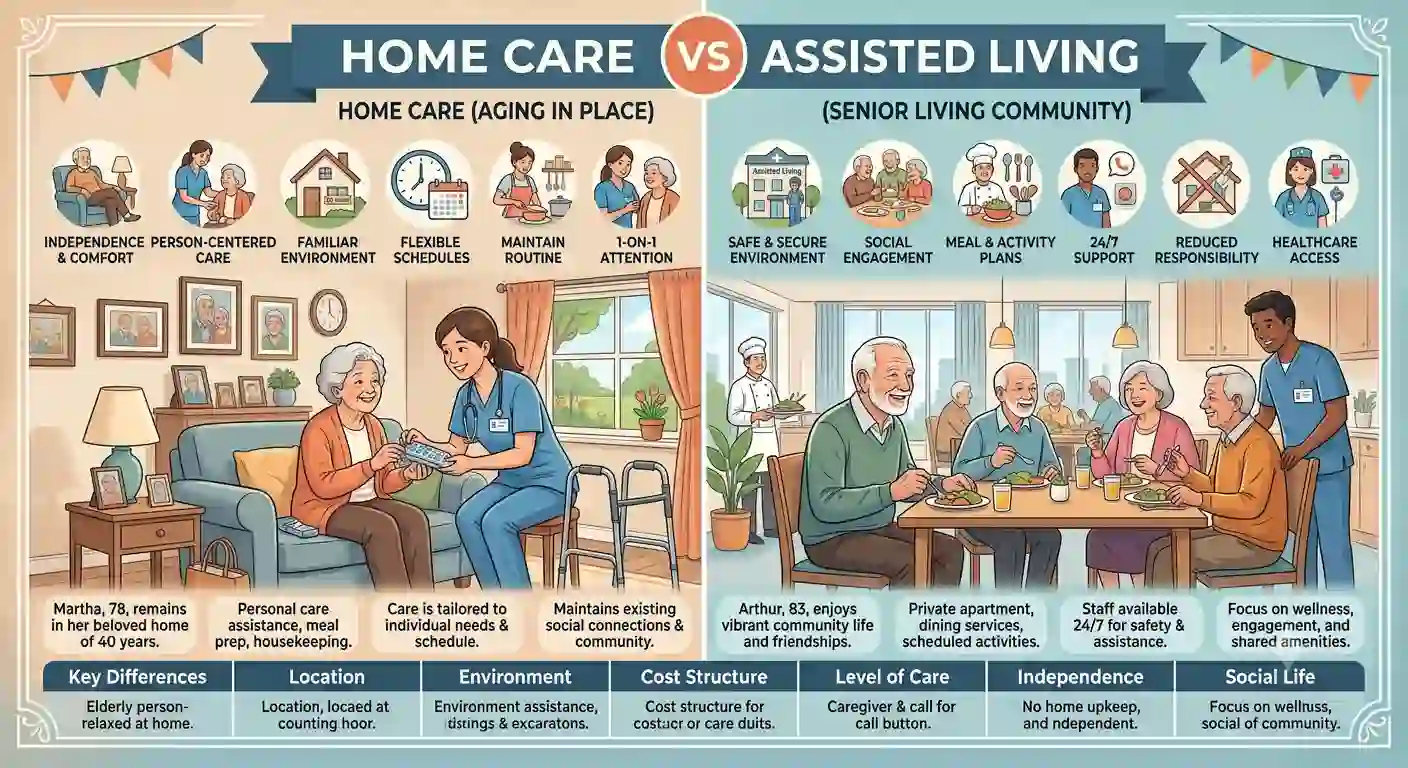
Introduction: Navigating the Senior Care Crossroads
Watching a parent grow older brings a complex mix of emotions. You want to honor their independence, protect their health, and ensure their golden years are spent in safety and comfort. However, when everyday tasks like cooking, bathing, managing medication, or keeping up with housework start becoming overwhelming, families face one of the most significant decisions of their lives: Should we choose in-home care or transition to an assisted living community?
This decision is rarely simple. It touches on personal independence, family finances, physical health needs, and emotional well-being. According to research from the AARP, nearly 90% of adults aged 50 and older prefer to age in place—remaining in their home and community for as long as possible. Yet, as health conditions progress, care demands can expand rapidly, placing immense strain on family caregivers who balance careers, personal lives, and care duties.
Whether you are noticing subtle red flags or facing an immediate post-hospitalization decision, this comprehensive guide will give you clarity. We will unpack the definitions, evaluate side-by-side comparisons, analyze short-term and long-term costs, examine memory and specialized medical care needs, and guide you through a step-by-step decision framework to choose the best path forward for your aging parent.
Defining the Options: What Are Home Care and Assisted Living?
Before comparing these two paths, it is vital to understand what each service entails. Senior care terminology can sometimes be confusing, particularly when distinguishing between non-medical assistance and skilled medical care.
1. In-Home Care (Caregiving at Home)
In-home care allows older adults to remain in the comfort and familiarity of their own residence while receiving professional assistance. Services range from a few hours of companion care a week to 24/7 round-the-clock supervision or live-in assistance.
In-home services primarily focus on non-medical support with Activities of Daily Living (ADLs) and Instrumental Activities of Daily Living (IADLs), including:
- Personal Care: Bathing, grooming, dressing, toileting, and mobility assistance.
- Homemaking: Meal preparation, light housekeeping, laundry, and grocery shopping.
- Companionship: Social interaction, cognitive engagement, and transportation to appointments.
- Medication Reminders: Ensuring prescriptions are taken accurately on schedule.
Key Distinction: It is crucial to distinguish non-medical home care from home health. For a detailed breakdown of medical vs. non-medical care under California regulations, read our article on Home Health vs. Home Care in California: What’s the Difference?.
2. Assisted Living Communities
Assisted living facilities are residential communities designed for seniors who require assistance with daily tasks but do not need the continuous, high-level skilled medical oversight provided by a traditional nursing home.
Residents live in private or semi-private apartments or suites within a managed facility. Key features include:
- 24-Hour Staff Availability: Support is available at the press of a call button.
- Communal Dining: Three structured meals served daily in a shared dining hall.
- Built-in Socialization: Organized group activities, outings, exercise classes, and entertainment.
- Property Maintenance: Housekeeping, laundry, and building repairs are handled by facility staff.
In-Depth Comparison: Home Care vs. Assisted Living
To determine which environment suits your parent, let’s look closely at how these options compare across key categories:
| Care Feature | In-Home Care | Assisted Living Community |
| Care Ratio | Dedicated 1-on-1 personal attention | Shared care ratio (1 caregiver to 8–15 residents) |
| Living Environment | Familiar home surrounded by personal memories | New apartment unit within a larger institution |
| Daily Routine | Completely tailored to individual preferences | Structured schedule for meals, activities, and routines |
| Independence Level | Maximum autonomy over daily choices | Structured independence within community guidelines |
| Social Opportunities | One-on-one outings, family visits, community trips | Daily group activities, shared dining, peer neighborhood |
| Safety Adjustments | Requires home modifications (ramps, grab bars) | Purpose-built accessible facilities (elevators, zero-step showers) |
| Flexibility | Scale hours up or down as needed | Fixed monthly baseline fees with tiered care add-ons |
1. Level of Personal Attention
- In-Home Care: Provides undivided, 1-on-1 attention. A caregiver focuses entirely on your parent’s safety, hydration, nutrition, and comfort throughout their shift. This tailored focus lowers the risk of neglected needs or unobserved changes in health.
- Assisted Living: Staff members oversee dozens of residents simultaneously. While assistance is available when requested via call pendants, staff members divide their time among all community members. Response times can vary during peak hours.
2. Routine and Personal Autonomy
- In-Home Care: Your parent maintains full control over their personal life. They choose when to wake up, what and when to eat, what TV shows to watch, and how to structure their evening. For seniors who value independence, preserving these familiar routines supports self-esteem and mental health.
- Assisted Living: Communities operate on structured timelines. Meals are served during set dining windows, activities follow a master monthly calendar, and shower schedules are planned around staff availability.
3. Environment and Adaptability
- In-Home Care: Relocating can be stressful for older adults, particularly those experiencing memory loss or cognitive decline. Staying at home allows aging parents to remain in familiar surroundings near lifelong neighbors, gardens, and pets.
- Assisted Living: Transitioning requires downsizing, packing up years of possessions, and adjusting to a smaller, unfamiliar setting. However, for seniors who feel isolated or overwhelmed by property maintenance, a fresh start in a community setting can feel liberating.
Evaluating the Financial Side: Cost Breakdown & Funding
Understanding the real financial commitment of senior care is essential for long-term planning. Families often assume assisted living is always cheaper than home care, or vice versa. The real answer depends entirely on the number of care hours required each week.
Financial Comparison: A Close Look
Data from the CareScout Cost of Care Survey provides a helpful benchmark for average long-term care costs:
- Assisted Living National Median Cost: Approximately $6,200 per month ($74,400 per year). Note that in high-cost metro regions, baseline rates frequently range from $5,500 to $8,500+ per month, with extra charges for tiered care services (such as assistance with medication or mobility).
- In-Home Care National Median Rate: Approximately $35 per hour.
- Part-Time Care (20 hours/week): ~$3,000 per month.
- Full-Time Care (44 hours/week): ~$6,160 per month ($73,920 annually).
- 24/7 Round-the-Clock Care: $15,000–$20,000+ per month.
For precise regional details, read our complete breakdown on The Cost of In-Home Care in San Diego: A Transparent Breakdown.
The “Cost Cross-Over Point”
- Part-Time Home Care (1 to 35 Hours/Week): Typically range from $1,500 to $4,800 per month. This is usually the most cost-effective solution when a senior needs help for part of the day while retaining relative independence.
- Moderate Home Care (35 to 60 Hours/Week): Runs between $4,800 and $8,500 per month. At this tier, costs reach parity with middle-to-upper tier assisted living facilities.
- 24/7 Round-the-Clock Care (60+ Hours or Continuous Care): Ranges from $12,000 to $18,000+ per month. At this level, assisted living or memory care facilities provide a fixed monthly rate, unless maintaining 1-on-1 dedicated attention in a private home remains the primary preference.
Important Real Estate Factor: Staying at home often means your parent’s property is paid off or has low fixed housing expenses. In this scenario, home care lets families spend money strictly on care hours rather than paying for room, board, and property overhead at a facility.
How Care is Paid For: Fact vs. Fiction
Many families assume public programs cover long-term senior housing or non-medical assistance. Let’s clarify how common payment sources work:
- Medicare: Medicare does NOT pay for long-term residential assisted living or non-medical home care. According to the Centers for Medicare & Medicaid Services, Medicare only covers short-term, medically necessary home healthcare following an inpatient hospital stay or skilled nursing stay (Learn about what Medicare covers).
- Long-Term Care Insurance (LTCI): Comprehensive long-term care insurance policies generally cover both licensed in-home care and care in accredited assisted living communities once the policyholder meets benefit triggers (typically needing help with 2 or more ADLs).
- Veterans Benefits (VA Aid & Attendance): Eligible wartime veterans and surviving spouses can receive tax-free pensions, such as the Aid and Attendance benefit from the U.S. Department of Veterans Affairs, to pay for home care aides or assisted living fees (Navigate San Diego Veteran Benefits for In-Home Senior Care.)
- Medicaid / Medi-Cal: Medicaid offers coverage for lower-income seniors. In California, Medi-Cal Home and Community-Based Services (HCBS) waivers can help fund in-home personal care to keep seniors from entering institutional care facilities.
Health, Safety, and Specialized Medical Needs
As adults age, chronic medical conditions and mobility limits often worsen. Weighing safety factors is critical when deciding between care options.
1. Fall Prevention and Mobility Risk
Falls are the leading cause of injury and loss of independence among older adults, according to the Centers for Disease Control and Prevention.
- In-Home Care: A professional caregiver provides direct, physical support during high-risk moments, like standing up, stepping into the shower, or walking to the bathroom at night. Caregivers also spot household hazards like throw rugs, poor lighting, or clutter. To make your parent’s living space safer, refer to our guide on How to Prevent Falls at Home: A Room-by-Room Senior Safety Checklist.
- Assisted Living: Facilities incorporate wide corridors, handrails, grab bars, and flat floor layouts. However, because staff attention is shared among many residents, a senior with balance issues may attempt to walk unassisted between check-ins, increasing the potential for unobserved falls.
2. Dementia and Cognitive Decline
Cognitive impairment caused by Alzheimer’s disease or vascular dementia presents unique safety challenges. For more background on disease progression, consult our detailed resource on Understanding Dementia Stages: A Guide for San Diego Families.
- In-Home Care for Early-to-Moderate Dementia: Environmental consistency is immensely helpful for managing cognitive symptoms. Remaining in a long-time home reduces anxiety, confusion, and late-afternoon agitation (sundowning). Personalized 1-on-1 home care allows routines to flex around the person’s mood and comfort level.
- Memory Care Facilities for Late-Stage Dementia: When severe cognitive decline causes continuous wandering, aggression, or high safety risks, locked memory care units inside assisted living facilities provide a secure physical environment with specialized staff to keep residents safe. Alternatively, dedicated 24/7 home care can maintain safety in the home. [A Daily Routine for Seniors with Dementia: Reducing Anxiety and Sundowning]
3. Managing Complex Medical Conditions
Neither traditional non-medical home care agencies nor standard assisted living facilities operate as hospitals or skilled nursing units. However:
- Home care agencies coordinate closely with home health nurses, physical therapists, and physicians to deliver customized assistance for conditions like Parkinson’s, stroke recovery, heart failure, or COPD.
- Assisted living facilities have on-site nurses who coordinate basic medication administration, wellness checks, and visiting doctor visits. However, if your parent requires complex medical care, higher care fees or transfers to skilled nursing facilities may be necessary.
Socialization, Mental Well-Being, and Quality of Life
Physical health is only part of the puzzle—emotional well-being, mental engagement, and social connections are equally vital for a fulfilling life.
Combating Isolation: The Social Dynamic
Isolation poses real health risks to older adults. According to research highlighted by the National Institute on Aging, social isolation and loneliness are linked to higher risks of heart disease, depression, and cognitive decline.
- Assisted Living: Communities offer built-in social opportunities. Residents can walk down the hall to play cards, attend exercise classes, enjoy live music, or share daily meals with peers. For naturally outgoing seniors, this atmosphere can revitalize their social life.
- In-Home Care: A professional caregiver provides dedicated one-on-one companionship, sharing meals, reading together, working on hobbies, and accompanying your parent on visits to local parks, worship services, or family gatherings.
Emotional Comfort and Routine
For many seniors, leaving their home feels like losing their independence. Their home holds decades of memories, familiar gardens, beloved pets, and comfortable routines. Moving to an assisted living facility requires adjusting to unfamiliar noises, building rules, institutional schedules, and rotating staff.
Key Takeaway: If an older adult values privacy, quiet surroundings, personal routine, or their pets, remaining at home with dedicated support often delivers better emotional well-being and peace of mind.
Impact on Family Caregivers: Stress, Burnout, and Family Harmony
Choosing senior care isn’t only about the aging parent; it deeply affects the entire family network.
Family caregivers often take on overwhelming levels of stress, trying to balance full-time jobs, child-rearing, personal health, and caregiving duties. Over time, caregiver burnout can manifest as fatigue, anxiety, depression, and physical illness, as documented by the Family Caregiver Alliance.
How Home Care Relieves Family Stress
Bringing professional caregivers into the home lets family members step back from exhausting daily chores and return to their primary role as loving sons or daughters. Professional caregivers handle bathing, toileting, and housework, allowing family visits to focus on meaningful connection, emotional support, and shared memories.
How Assisted Living Relieves Family Stress
Assisted living takes property maintenance, meal planning, house repairs, and round-the-clock safety concerns entirely off the family’s plate. However, families often spend considerable time managing care oversight, attending care plan meetings, running external errands, and helping their parent adapt emotionally to communal living.
For families struggling to step back from hands-on caregiving tasks, read our helpful guide on 7 Signs Your Loved One Needs In-Home Care[cite: 1].
Decision Framework: Step-by-Step Selection Guide
To help you decide between home care and assisted living, work through this step-by-step evaluation framework with your family:
Step 1: Assess Safety and Mobility Needs
- Can your parent navigate their living space safely with basic modifications?
- Are they experiencing unexplainable bruises, frequent falls, or near-misses?
- Do they need assistance getting out of bed or using the bathroom at night?
Step 2: Estimate Weekly Care Hours
- Do they only need help with cooking, errands, and morning routines (10–30 hours/week)? –> Points to In-Home Care.
- Do they require constant, 24/7 supervision due to advanced dementia or severe physical disabilities? –> Points to Memory Care, Assisted Living, or Full-Time Home Care.
Step 3: Review Personal Finances and Long-Term Assets
- Does your parent own their home with low monthly overhead?
- Do they have an active Long-Term Care Insurance policy or VA benefits?
- Is their preference to protect home equity or downsize to simplify liquid finances?
Step 4: Honor Personal Preferences and Social Needs
- Is your parent an introvert who prefers quiet surroundings, familiar pets, and personal hobbies? –> Points to In-Home Care.
- Are they feeling lonely, craving daily peer interaction, and eager to participate in organized group events? –> Points to Assisted Living.
Step 5: Consider a Trial Period
You don’t have to commit permanently right away. Many families start with part-time in-home care services for 60 to 90 days. This lets you evaluate your parent’s response, measure health improvements, and assess family stress before making long-term moves or real estate decisions.
Comparing Options Side-by-Side: Pros and Cons
To help summarize your decision, here is a breakdown of the key benefits and potential drawbacks of both senior care paths:
In-Home Care
- Pros:
- Allows your parent to stay in their familiar, comfortable home environment.
- Delivers dedicated, one-on-one personalized attention.
- Preserves personal routines, daily habits, independence, and pets.
- Flexible schedule that scales up or down based on actual needs.
- Cost-effective for part-time, moderate, or transitional care requirements.
- Cons:
- Can become expensive if full 24/7 continuous awake coverage is required.
- Requires ongoing maintenance and safety adjustments to the private home.
Assisted Living Communities
- Pros:
- Includes room, board, dining, housekeeping, and maintenance in a predictable base monthly fee.
- Provides built-in group activities, peer socialization, and shared dining.
- Features purpose-built accessible facilities with 24/7 on-site staff.
- Cons:
- Care attention is shared among many residents (not 1-on-1).
- Requires downsizing, moving, and adjusting to institutional schedules.
- Base monthly fees increase as care needs advance into higher tiers.
Essential Questions to Ask Before Choosing an Option
Whether you are interviewing home care agencies or touring local assisted living communities, asking targeted questions will help you find the right fit:
Questions for Home Care Agencies
- How do you screen, background-check, and train your caregivers?
- How do you match caregivers with a client’s personality and preferences?
- What is your process if a primary caregiver falls ill or calls in absent?
- How do you track care tasks and communicate daily updates to family members?
- Are your care plans flexible if my parent’s health needs change?
Questions for Assisted Living Communities
- What is your direct caregiver-to-resident ratio during day and night shifts?
- What specific services are covered in the base price versus extra tiered care fees?
- How does your staff handle sudden changes in health conditions or emergencies?
- What is your resident turnover rate, and how long does leadership staff stay?
- What happens if a resident exhausts their private funds over time?
Conclusion: Making the Best Decision for Your Aging Parent
There is no single “right” answer when choosing between home care and assisted living. The best choice depends on your parent’s personal health requirements, financial resources, emotional preferences, and family dynamics.
If your aging parent cherishes their independence, values familiar surroundings, and needs customized support with daily tasks, in-home care offers a compassionate, flexible, and empowering solution. Staying at home allows them to age in place safely while preserving their dignity, personal routines, and quality of life.
Take the time to talk open-heartedly with your parent, consult with healthcare professionals, and explore quality local care options. With thoughtful planning, patience, and reliable support, you can help your parent live out their golden years with comfort, security, and peace of mind.
Key Takeaways Summary
- In-Home Care provides dedicated 1-on-1 support, allowing seniors to age in place in familiar, comfortable surroundings.
- Assisted Living offers residential community living with shared care staff, group activities, and communal dining.
- Home care is often more cost-effective for part-time to moderate needs (under 40–50 hours per week).
- Medicare does NOT cover long-term non-medical home care or residential assisted living fees.
- 1-on-1 home care delivers tailored support for fall prevention, cognitive engagement, and individual routines.
Helpful External Resources
To assist your family in evaluating options, explore these national senior care organizations:
- Learn about long-term care options and family caregiving at AARP.
- Access research on aging, health, and memory care through the National Institute on Aging.
- Review mobility safety and senior fall prevention guidelines at the Centers for Disease Control and Prevention.
- Track long-term care financial metrics using the CareScout Cost of Care Survey.
- Find disease education and support resources at the Alzheimer’s Association.
- Explore military pension and caregiver support options via the U.S. Department of Veterans Affairs.
- Understand federal healthcare policy and coverage rules at the Centers for Medicare & Medicaid Services.
- Find expert guidance on senior chronic conditions at the Mayo Clinic.
- Discover community-based senior services and economic support at the National Council on Aging.
- Access caregiver support networks and practical tools through the Family Caregiver Alliance.