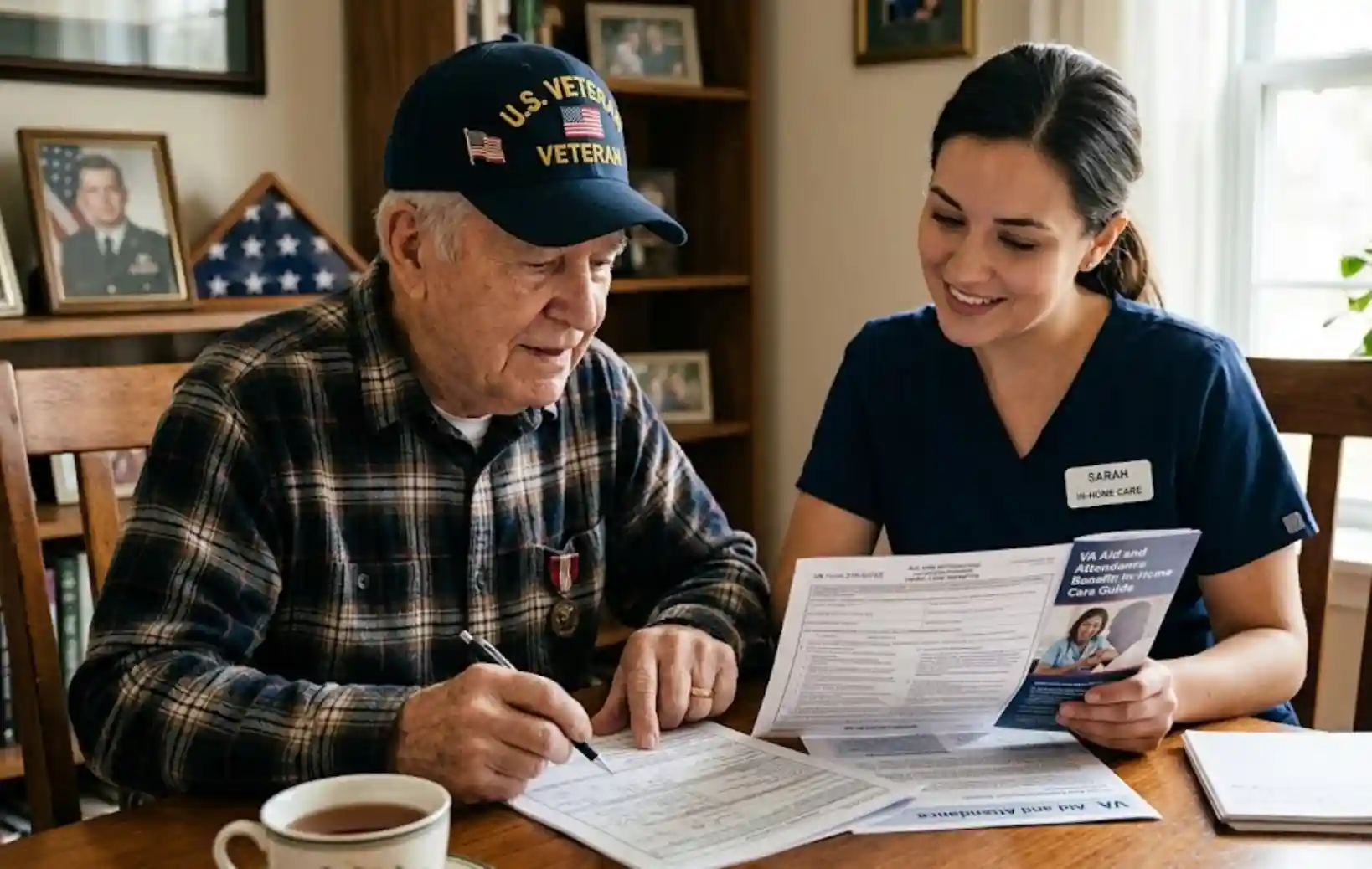
As our parents and loved ones age, the desire to remain at home is incredibly strong. However, the cost of private, professional in-home care can quickly strain a family’s budget. For veterans and their surviving spouses, a hidden lifeline often exists within the Department of Veterans Affairs (VA): the Aid and Attendance benefit.
This benefit is an un-indexed, tax-free pension enhancement that can provide thousands of dollars per month specifically to offset the cost of long-term care, including private home care. Yet, due to complex eligibility rules and a notoriously bureaucratic application process, millions of qualifying families leave this money on the table.
This guide provides a comprehensive breakdown of the VA Aid and Attendance benefit for in-home care, detailing eligibility requirements, the application process, and strategies to secure the financial support your family deserves.
What is the VA Aid and Attendance Benefit?
The Aid and Attendance benefit is not a standalone program. It is an increased monthly pension amount paid to eligible veterans and surviving spouses who require the regular assistance of another person to perform everyday tasks (Navigate San Diego Veteran Benefits for In-Home Senior Care.)
Because it is an enhancement to the basic VA Pension (or the Surviving Spouse Pension), you must first meet the baseline requirements for the wartime pension before the VA evaluates your clinical and physical need for the Aid and Attendance allowance.
Unlike standard VA medical care, which is often tied to service-connected disabilities or delivered at VA clinics, Aid and Attendance provides direct financial compensation. This allows you to hire a private duty home care agency to assist with daily living in the comfort of your own home. [10 Questions You Must Ask When Interviewing In-Home Care Agencies in San Diego]
2026 Monthly Payment Rates
The financial impact of this benefit is substantial. The VA adjusts these figures annually based on cost-of-living metrics. The maximum monthly pension rates for Aid and Attendance typically follow these structures:
- Two Veterans Married to Each Other: Up to $3,900+ per month
- Married Veteran (with One Dependent): Up to $2,700+ per month
- Single Veteran: Up to $2,300+ per month
- Surviving Spouse: Up to $1,500+ per month
These funds are paid directly to the beneficiary via direct deposit and are completely tax-free. They can be spent on any legitimate home care service, including companion care, personal care, and specialized dementia supervision.
The Four Pillars of VA Aid and Attendance Eligibility
To successfully secure this benefit, an applicant must satisfy four distinct sets of criteria, often referred to as the Four Pillars.
1. The Military Service Pillar
The veteran must have served on active duty during an official window of wartime defined by Congress.
- Active Duty Requirement: Minimum of 90 days of active duty, with at least one day served during an official wartime period. (Veterans who entered active duty after September 7, 1980, generally must have served at least 24 months or the full period for which they were called to active duty).
- Discharge Status: The veteran must have received a discharge under conditions other than dishonorable (e.g., Honorable or General Under Honorable Conditions).
- Combat Experience: Combat service is not required. A logistics clerk stationed safely stateside during a wartime window meets this criterion exactly the same as a frontline infantryman.
Official Eligible Wartime Periods:
- World War II: December 7, 1941 – December 31, 1946
- Korean Conflict: June 27, 1950 – January 31, 1955
- Vietnam Era: November 1, 1955 – May 7, 1975 (for veterans who served in the Republic of Vietnam); otherwise, August 5, 1964 – May 7, 1975 for those serving anywhere else.
- Gulf War: August 2, 1990 – present day (a date to be set by Presidential proclamation or law).
2. The Clinical Need Pillar (Medical Criteria)
To qualify for the Aid and Attendance allowance on top of the base pension, the applicant must document a clear physical or cognitive need for regular human assistance. You do not need to prove that your health conditions are service-connected. You only need to meet at least one of the following criteria:
- ADL Assistance: You require the aid of another person to perform at least two Activities of Daily Living (ADLs). The VA defines these strictly as bathing, dressing, feeding yourself, toileting, or adjusting prosthetic or orthopedic appliances.
- Bedridden: Your disabilities require that you remain in bed apart from any prescribed course of treatment.
- Cognitive Impairment: You have a physical or mental injury or illness—such as Alzheimer’s disease or another form of dementia—that requires a safe, structured environment to protect you from harm. This is a crucial element for families managing dementia care, where physical mobility might be fine, but cognitive safety requires constant oversight.
- Visual Impairment: Your eyesight is limited to a corrected visual acuity of 5/200 or less in both eyes, or a peripheral field concentric contraction to 5 degrees or less.
If you are trying to determine if your loved one has reached the point where home care is necessary, reviewing a structural guide like the 7 Signs Your Loved One Needs In-Home Care can clarify whether their daily struggles align with the VA’s medical requirements.
3. The Income Pillar (IVAP)
The financial math behind the VA pension can be confusing. The VA calculates your eligibility based on your Income for VA Purposes (IVAP). Your IVAP is determined by taking your gross household income and subtracting your recurring, unreimbursed medical expenses.
$$\text{IVAP} = \text{Gross Household Income} – \text{Unreimbursed Medical Expenses}$$
If your gross income is $5,000 per month, but your recurring home care costs are $4,500 per month, your IVAP drops to $500. If your IVAP is lower than the maximum allowable pension rate, the VA pays a benefit that bridges the gap.
Because professional home care is a legitimate medical expense, the cost of an agency can actually drive your IVAP down to zero, allowing you to qualify for the maximum allowable monthly payout.
4. The Net Worth and Asset Pillar
The VA enforces a strict net worth ceiling to ensure the benefit helps those who truly need financial support. As of recent updates, the asset limit is aligned with the Medicaid community spouse resource allowance maximum (approximately $155,000+, adjusted annually).
- What Counts: All liquid investments, retirement accounts (IRAs, 401ks), savings, checking accounts, and secondary properties.
- What is Exempt: Your primary home (including the land it sits on, up to two acres), one vehicle, and standard personal household items.
- The Look-Back Rule: Be aware that the VA enforces a 3-year look-back period on asset transfers. If you gift money to relatives or move stocks into an irrevocable trust to artificially lower your net worth within 3 years of filing, the VA can impose a multi-year penalty period during which benefits are withheld.
In-Home Care vs. Home Health Care: What the VA Covers
It is essential to distinguish between Skilled Home Health Care and Personal In-Home Care when planning your budget.
- VA Home Health Care: Managed directly through the Veterans Health Administration, this clinical care is ordered by a VA physician. It involves short-term, intermittent visits from physical therapists, wound care nurses, or occupational therapists.
- Private Duty In-Home Care: Funded via the Aid and Attendance pension enhancement, this covers long-term, non-skilled assistance. It includes companion care, meal preparation, medication reminders, light housekeeping, and specialized hands-on help for seniors dealing with progressive mobility issues.
For instance, if a veteran is managing complex physical challenges, integrating Aid and Attendance funds with an agency that understands In-Home Care for Parkinson’s and Movement Disorders ensures comprehensive coverage. The home remains safe, medication cycles are precisely managed, and family members are protected from physical exhaustion.
Step-by-Step Application Process
The VA application process requires meticulous documentation. Missing a single signature or medical checkmark can delay your claim by six to twelve months.
Step 1: Gather Critical Documentation
Before downloading the official pension applications, secure the underlying personal records that verify your military and financial status:
- The DD-214 Form: The official military separation record proving wartime dates and discharge status. If you have lost this document, request an expedited copy online via the National Archives eVetRecs system.
- Financial Records: The last 12 months of statements for every bank account, stock portfolio, and source of monthly income (Social Security statements, private pensions, annuity statements).
- Medical Documentation: Written validation of any current clinical diagnoses, especially formal evaluations for cognitive issues or neurological deficits.
Step 2: Establish the Effective Date (Intent to File)
Processing a claim can take months. To avoid losing out on retroactive payments while you collect paperwork, submit an Intent to File a Claim for Compensation and/or Pension (VA Form 21-0966). You can complete this online through VA.gov or mail it directly to the pension management center.
Once received by the VA, this form locks in an effective date. If your eventual application is approved, the VA will pay back-benefits retroactive to the first day of the month following your Intent to File submission.
Step 3: Complete the Core Application Packets
You will need to accurately execute a series of distinct VA documents:
- VA Form 21P-527EZ: The primary application for Veterans Pension. (If you are a surviving spouse applying based on your late partner’s record, use VA Form 21P-534EZ).
- VA Form 21P-530: Used to declare income and net worth variables transparently.
- VA Form 21-2680 (Examination for Housebound or Aid and Attendance): This is the heart of your medical claim. It must be filled out, signed, and dated by a licensed medical provider (your family doctor or a VA physician). The physician must explicitly state that you cannot manage independent living safely without human assistance, specifically detailing your limitations with bathing, dressing, or cognitive tracking.
- VA Form 21P-8416 (Medical Expense Report): Use this to calculate your recurring out-of-pocket medical costs. Itemize every recurring dollar spent on licensed home care agencies, health insurance premiums, and prescription costs to ensure your IVAP is driven down as far as possible.
Step 4: Submit and Track Your Claim
Compile all forms, signed doctor statements, financial documents, and the DD-214 into a single organized packet. Make a complete photocopy for your own personal files.
Submit the packet securely via the VA AccessVA Centralized Mail portal or mail it via Certified Mail with return receipt requested to the designated regional VA Pension Management Center.
Common Red Flags That Cause Delays or Denials
Filing for VA benefits can be challenging. Working care coordinators see the same administrative mistakes cause automatic denials year after year:
- Incomplete Caregiver Invoices: If you claim home care costs as a recurring medical deduction, the care contract or invoice must break down tasks cleanly. It should explicitly demonstrate that the caregiver is providing assistance with ADLs or safety supervision, rather than just acting as a casual housekeeper.
- Mismatched Income Declarations: Gross income figures listed on your tax records or Social Security statements must match your application exactly. Discrepancies will trigger a formal audit, delaying your file significantly.
- Undocumented Asset Transfers: Attempting to shift assets to relatives right before applying will trigger the three-year look-back penalty. If asset adjustments are necessary, consult a credentialed elder law attorney or an accredited VA agent long before submitting documents.
For family members juggling these administrative hurdles while maintaining a demanding job, these delays add tremendous pressure. Reviewing resources like Tips for Caring for Elderly Parents While Working Full-Time can provide functional tips for balancing these tasks without burning out.
How Long Does Approval Take? (And the Retroactive Payout)
The typical processing window for an Aid and Attendance pension claim runs between 4 to 9 months. Factors influencing this timeline include the seasonal caseload of the regional pension center, the completeness of your medical documentation, and how quickly your physician responds to secondary validation requests.
Fortunately, the benefit is retroactive. If your application takes six months to approve, your first check will include a lump-sum back payment covering those six months of waiting, dating back to your initial “Intent to File.” This retroactive payment helps families reimburse their savings accounts for care expenses paid out-of-pocket during the processing window.
Professional Assistance Options
You do not have to navigate the VA infrastructure alone. There are free and paid advocacy options available to guide you through the process:
- Veterans Service Officers (VSOs): Congressionally chartered organizations like the Disabled American Veterans (DAV), the American Legion, and VFW offer accredited, free assistance. VSOs can review your forms and submit claims directly through the VA electronic portal.
- Accredited VA Attorneys and Agents: For complex asset portfolios or cases requiring structured care plans, you can hire an independent professional. Ensure they are listed on the VA Office of General Counsel Accredited Search database to confirm they are legally recognized by the department.
Securing High-Impact Care at Home
Once your Aid and Attendance benefit is established, choosing the right in-home partner is the final step to ensuring long-term safety and comfort. Look for an agency that matches professional caregivers to your specific health requirements, tracks daily changes, and coordinates directly with your family.
Navigating wartime pension applications takes patience, but the outcome can completely transform your family’s care dynamic. By securing the Aid and Attendance benefit, you honor your loved one’s military service with the practical, comfortable, and dignified care they deserve right at home.