For family caregivers protecting an aging parent or a loved one with a progressive neurological condition, maintaining health at home requires constant vigilance. While many families focus heavily on visible safety concerns like fall prevention or medication management, one of the most critical threats to senior health happens quietly at the dinner table: aspiration pneumonia.
Aspiration pneumonia is a serious, life-threatening lung infection that develops when food, liquids, saliva, or vomit are accidentally inhaled into the respiratory tract instead of passing safely down the esophagus into the stomach. In young, healthy individuals, a powerful cough reflex instantly clears this misdirected material. However, in older adults—especially those managing conditions like stroke, Parkinson’s disease, advanced dementia, or general frailty—the physical mechanisms that protect the lungs are often severely compromised.
According to clinical data, pneumonia remains a leading cause of hospitalization and mortality among older adults, with aspiration serving as a primary driver in frail or neurologically impaired seniors. When foreign matter carries oral bacteria deep into the lung tissue, it triggers a rapid, aggressive inflammatory response that can quickly overwhelm an aging immune system.
This comprehensive guide transforms complex medical concepts into an actionable roadmap for home caregivers. By understanding the underlying mechanics of aspiration, recognizing the hidden warning signs, mastering preventative feeding strategies, and optimizing oral health, you can build a robust safety net that protects your loved one’s respiratory health and preserves their quality of life.
1. What is Aspiration Pneumonia? Mechanics and Risk Factors
To effectively defend against aspiration pneumonia, caregivers must understand the anatomical changes that occur as the human body ages or encounters chronic disease.
Swallowing is a highly complex, rapid-fire sequence of muscular contractions and neurological signals. In a healthy throat, a small, leaf-shaped flap of cartilage called the epiglottis acts as a structural railroad switch. When you swallow, the epiglottis instantly folds backward to seal off the larynx and trachea (the windpipe), forcing food and liquid to slide safely into the esophagus.
In many seniors, this beautifully coordinated sequence breaks down. When foreign material slips past the vocal cords and enters the bronchial tubes, it introduces pathogens into an environment that must remain completely sterile. The resulting infection is what clinicians classify as aspiration pneumonia.
Major Risk Factors and Contributing Conditions in Aspiration Pneumonia in Seniors
Aspiration pneumonia rarely occurs in a vacuum; it is almost always the consequence of an underlying physical or cognitive vulnerability.
- Advanced Dementia and Alzheimer’s Disease: In the moderate to severe stages of cognitive decline, the brain gradually forgets how to coordinate the muscles involved in chewing and swallowing. Seniors may forget they have food in their mouth, attempt to swallow multiple textures at once, or lose the cognitive pacing required to breathe and eat safely.
- Parkinson’s Disease and Movement Disorders: Neurodegenerative conditions like Parkinson’s and Progressive Supranuclear Palsy (PSP) cause severe muscle rigidity, tremors, and slow movements (bradykinesia). The tongue may develop an inefficient “rolling” motion that fails to move food backward cleanly, and the throat muscles may lag significantly behind the brain’s intent, leaving the airway wide open when a swallow occurs.
- Post-Stroke Paralysis: A stroke can leave one side of the mouth, tongue, and throat profoundly weak or paralyzed. Food can easily collect on the weakened side of the mouth, sliding down into the airway unnoticed.
- General Frailty and Chronic Deconditioning: Severe physical weakness, prolonged bed rest, or chronic respiratory conditions like COPD drain an older adult of the muscular stamina required to execute a strong, protective swallow or maintain an upright posture during meals.
- Medication Side Effects: Many common prescriptions—including muscle relaxants, heavy pain medications, sedatives, and certain anti-anxiety drugs—dull the central nervous system, drastically slowing down natural reflexes and inducing lethargy during mealtimes.
2. Overt vs. Silent Aspiration: Catching the Hidden Signs
Most people believe that if an older adult is not experiencing dramatic choking fits, gasping for air, or coughing violently at the table, their swallowing is perfectly safe. This is a dangerous misconception.
While overt aspiration presents with these clear, unmistakable distress signals, the far more insidious threat is silent aspiration.
The Danger of Silent Aspiration
Silent aspiration occurs when foreign material enters the lungs without triggering a cough reflex or any visible signs of respiratory distress. This happens because chronic illnesses or the natural aging process can desensitize the sensory nerves inside the throat. The brain literally does not realize that food or fluid is entering the respiratory system, so it never sends the signal to cough.
As a home caregiver, you must train your senses to detect the subtle, non-dramatic indicators that occur during or immediately after meals.
Immediate Red Flags During and After Meals
- The “Wet” or Gurgly Voice: If your loved one speaks after taking a sip or a bite and their voice sounds damp, gravelly, or as if they are talking through water, stop the meal immediately. This sound indicates that material is sitting directly on top of the vocal cords and has not been cleared.
- Frequent Throat Clearing: Minor, repetitive clearing of the throat throughout a meal is a subtle sign that the body is attempting to manage material slipping toward the airway.
- Watery Eyes or Sudden Runny Nose: A sudden physiological response—like a flush in the cheeks, tearing up, or a clear nasal discharge while eating—often points to an automatic autonomic nervous system reaction to a threatened airway.
- Multiple Swallows Per Bite: If you notice your loved one must swallow three or four times to process a single, small teaspoon of food, their throat clearing mechanism is working inefficiently.
- Pocketing Food: Storing unswallowed food in the side recesses of the cheeks (often on a side weakened by a stroke) is a major aspiration trigger, as that food can slide into the throat long after the meal has ended.
Delayed Red Flags to Monitor for Aspiration Pneumonia in Seniors
Aspiration can happen gradually over days. Monitor your loved one for these systemic changes:
- Unexplained Low-Grade Fevers: A spike in temperature that appears out of nowhere, particularly a few hours after a meal, often signals that the immune system is starting to fight an influx of bacteria in the lungs.
- Rapid or Shallow Breathing: Count your loved one’s respirations at rest. A sudden baseline increase in breathing rate or visible effort in the chest walls indicates respiratory strain.
- A Rattling Chest Sound: Chronic congestion, a persistent moist cough, or a distinct rattling sound in the chest during breathing—especially when lying down—is a classic sign of fluid accumulation.
- Sudden Fatigue or Mental Status Changes: In older adults, a lack of oxygen or an impending infection frequently manifests as sudden lethargy, increased confusion, or a rapid decline in cognitive clarity rather than a classic high fever.
3. Clinical Interventions: The Role of the SLP and Diagnostic Testing in Aspiration Pneumonia in Seniors
If you observe any of these warning signs, it is crucial to avoid guesswork. Modifying a loved one’s diet based on a hunch can inadvertently worsen the problem. Instead, advocate immediately for a professional clinical evaluation.
The cornerstone of dysphagia (swallowing disorder) management is the Speech-Language Pathologist (SLP). While many associate these therapists exclusively with speech clarity, they are the foremost medical experts in the mechanics of the throat and swallowing safety.
What Occurs During an Evaluation for Aspiration Pneumonia in Seniors
An SLP will typically begin with a comprehensive clinical bedside swallow assessment. They will evaluate the physical strength of your loved one’s jaw, lips, and tongue, check their cognitive ability to follow instructions, and carefully observe their physical response to various controlled food textures and liquid thicknesses.
If the bedside assessment suggests that material is bypassing the airway unprotected, the SLP will request one of two highly precise diagnostic imaging studies:
Modified Barium Swallow Study (MBSS) / Videofluoroscopic S
wallow Study
This test is conducted in a hospital radiology suite. Your loved one is fed small samples of foods and liquids mixed with barium, a safe contrast material. An active X-ray video records the entire swallow in real time, allowing clinicians to see exactly where the food travels, confirm if silent aspiration is occurring, and determine which specific physical movements or modifications alleviate the breakdown.
Fiberoptic Endoscopic Evaluation of Swallowing (FEES)
During a FEES test, a micro-thin, flexible endoscope equipped with a camera is passed gently through the nose to sit just above the throat. This provides a direct, high-definition overhead view of the vocal cords and airway while the individual eats, revealing exactly how much food residue is left behind or if any slips beneath the larynx.
4. Dietary Modifications: Textures, Liquids, and the IDDSI Scale
Once diagnostic testing identifies exactly what your loved one can safely process, the SLP will issue a specific dietary prescription. Globally, medical professionals use the International Dysphagia Diet Standardisation Initiative (IDDSI) framework to eliminate confusion between families, doctors, and care providers.
The IDDSI framework uses a highly specific, color-coded scale ranging from Level 0 to Level 7 to categorize food textures and liquid thicknesses.
Navigating Liquid Thicknesses (Levels 0 to 4)
Counterintuitively, thin liquids (Level 0) like plain water, tea, commercial juices, and coffee are the single most dangerous items for a senior with a compromised swallow. Thin liquids move at an incredibly high velocity. If tongue control is weak, the liquid splashes over the back of the throat before the brain has time to signal the epiglottis to close, leading straight to the lungs.
To slow the flow down, clinicians often mandate the use of thickening agents to reach specific safety levels:
- Level 1 (Slightly Thick): Thicker than standard water, but still flows easily through a straw (e.g., natural commercial nectars).
- Level 2 (Mildly Thick): Runs off a spoon quickly but leaves a visible film behind. It can be sipped from a cup with mild effort.
- Level 3 (Moderately Thick / Liquidized): Moves slowly off a tilted spoon and cannot be easily sucked through a standard drinking straw.
- Level 4 (Extremely Thick / Pureed): Sits compactly on a spoon like pudding. It holds its shape completely and cannot be drunk from a cup; it must be consumed with a spoon.
Starch-Based vs. Xanthan Gum Thickeners
When purchasing over-the-counter thickeners, pay close attention to the active ingredient:
- Modified Food Starch: These traditional powders are widely available but can leave a cloudy appearance and a slightly chalky taste. Crucially, they can continue to thicken the longer they sit in a glass, and an enzyme in human saliva (amylase) can break down the starch in the mouth, occasionally thinning the liquid back out before it passes the throat.
- Xanthan Gum: Modern xanthan gum thickeners mix completely clear, do not alter the natural flavor of the drink, maintain an identical thickness level indefinitely, and are entirely resistant to salivary breakdown, making them highly reliable for safety.
Mastering Food Textures (Levels 4 to 7)
- Level 4 (Pureed): Food must be completely smooth, uniform, and entirely free of lumps, seeds, or stringy fibers. It should not require chewing.
- Level 5 (Minced & Moist): Food must be soft, thoroughly saturated with moisture (gravy or sauce), and pre-cut into tiny particles. For adults, these particles must be no larger than 4mm—which is precisely the width of the gap between the prongs of a standard dinner fork.
- Level 6 (Soft & Bite-Sized): Food must be naturally tender and cut into bite-sized pieces no larger than 1.5cm x 1.5cm (the average width of an adult thumbnail). The pieces must easily squash and break apart when pressed firmly with a fork, without bouncing back.
Critical Caregiver Alert on “Mixed Consistencies”: Avoid serving foods that combine a solid floating inside a thin liquid—such as traditional chicken noodle soup, cold cereal with milk, or incredibly juicy fruits like fresh watermelons and oranges. The brain struggling with dysphagia cannot figure out how to chew the solid while simultaneously preventing the rapid liquid from flowing into the airway, resulting in an immediate aspiration hazard.
5. Safe Feeding Protocols: The Non-Negotiable Mealtime Rules
Preventing aspiration pneumonia depends heavily on the environmental and physical rules enforced during every single meal, snack, or sip of water. Implementing these protocols can drastically reduce the entry of pathogens into the respiratory tract.
The 90-Degree Seating Position
Never allow a senior to eat or drink while slouching backward, leaning to one side, or propped loosely up on pillows in bed.
- Your loved one must sit at a rigid 90-degree upright angle during all oral intake.
- If they are eating in a hospital bed, raise the head of the bed to its maximum vertical height. Slide pillows under their lower back and knees to prevent their hips from sliding forward into a semi-reclined slump.
The Chin-Tuck Maneuver
If explicitly evaluated and recommended by your SLP, encourage the chin-tuck. Rather than tilting the head backward to clear a cup (which naturally pulls open the airway like a wide funnel), have the senior tuck their chin slightly downward toward their chest right before they swallow. This simple physical adjustment pulls the base of the tongue backward, narrows the entrance to the windpipe, widens the path to the esophagus, and creates a natural umbrella effect over the lungs.
Creating a Low-Stimulus Environment
Mealtime must be treated as a focused health activity, not a social multitasking event.
- Turn off all background televisions, radios, and loud appliances.
- Enforce a strict no talking while chewing policy. Asking your loved one a question while they have food in their mouth causes a natural instinct to inhale sharply to answer, drawing the unswallowed food straight down into their airway.
Pacing and Spoon Mechanics
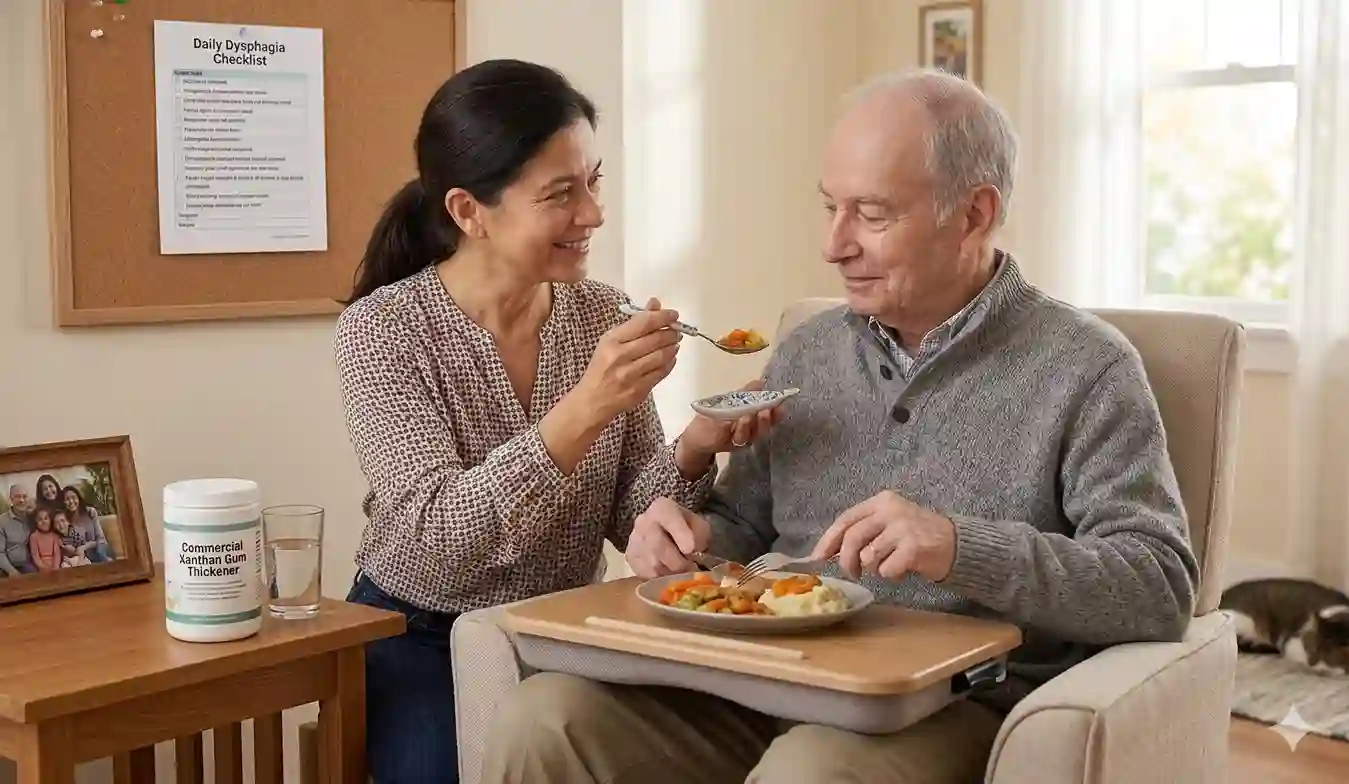
- Sit directly at eye level with your loved one when assisting them. Do not stand over them, as looking up at you forces their neck to tilt backward into a high-risk position.
- Use a small, shallow teaspoon instead of a large soup spoon to automatically control bolus sizes.
- Visually inspect their mouth after every single bite to confirm that the previous mouthful has been completely swallowed before offering the next taste.
The Post-Meal Upright Window
The danger of aspiration does not end when the plate is empty. If a senior lies flat immediately after a meal, undigested food and gastric acid can easily travel back up the esophagus (reflux) and slide directly down into the vulnerable airway.
The Golden Rule: Keep your loved one completely upright at a 90-degree angle (or at minimum a 45-degree angle if resting) for at least 30 to 60 minutes after every single meal or beverage consumption.
6. Oral Care: The Unspoken Lifesaver in Pneumonia Prevention
Many family caregivers are astonished to learn that a tooth brushing routine is one of the most powerful defenses against aspiration pneumonia.
Human beings naturally swallow micro-amounts of their own saliva all day and night. If a senior’s mouth is clean, the minor amounts of saliva they inevitably aspirate carry very little bacteria. However, if their mouth is dry, unbrushed, and coated in plaque, film, or lingering food particles, their saliva transforms into a highly concentrated bacterial soup. When that bacteria-laden fluid slips past weak throat muscles into the lungs, aspiration pneumonia develops rapidly.
Meticulous oral care can save your loved one’s life—even if they are entirely NPO (nothing by mouth) and relying exclusively on a PEG feeding tube.
A Comprehensive Dysphagia Oral Care Protocol for Aspiration Pneumonia in Seniors
1. Frequency
Perform complete oral cleanings at least twice daily, and visually sweep the mouth after every meal to remove hidden, pocketed debris.
2. Position for Safety
Ensure the senior is sitting upright. Never brush an older adult’s teeth while they are lying flat, as the water and secretions will pooling in the back of the throat and trigger choking.
3. Eliminate Foaming Toothpastes
Avoid standard commercial toothpastes that produce heavy foam. Foam coats the inside of the mouth, blocking your view and easily running down the throat to trigger a coughing spell. Instead, use a tiny smear of non-foaming prescription dental gel or an antibacterial oral rinse.
4. Utilize Advanced Tools
If your loved one cannot reliably spit or rinse, avoid pouring water into their mouth. Instead, use specialized suction toothbrushes connected to a portable machine, or use damp, medical-grade oral swabs (tootgettes) to gently lift away plaque, film, and debris.
5. Clean All Surfaces
Do not just brush the teeth. Gently scrub the gums, clean the roof of the mouth, wipe down the inside of the cheeks, and clean the tongue thoroughly, as this is where respiratory bacteria aggregate heaviest.
6. Denture Care
Remove dentures every single night. Scrub them with a dedicated denture brush and store them in an antimicrobial soaking solution. Regularly inspect the gums beneath the dentures for raw spots or fungal issues, which can make chewing painful and dramatically worsen dysphagia.
7. Emergency Response for Aspiration Pneumonia in Seniors
When a senior encounters a swallowing failure, caregivers must stay calm and immediately distinguish between a partial airway obstruction (a severe coughing fit) and a complete airway obstruction (true choking).
The Partial Obstruction (The Coughing Fit)
If your loved one misdirects a sip of liquid, turns red, and begins coughing forcefully, do not panic, and do not interfere.
- The Action Plan: As long as the individual is actively coughing, gasping, or able to make vocal sounds, air is successfully moving through their windpipe. A person’s natural cough reflex is incredibly powerful and is far more effective at clearing an obstruction than any physical intervention you can try.
- What to Avoid: Do not smack them forcefully on the back while they are upright, as this sudden impact can cause them to gasp sharply, accidentally pulling the foreign object deeper into the respiratory tract. Do not hand them a glass of water to “wash it down”—this simply pours liquid on top of a blocked airway. Stand by closely, provide quiet emotional reassurance, encourage them to keep coughing, and let the episode clear naturally.
The Complete Obstruction (True Choking Emergency)
If your loved one suddenly goes completely silent, turns pale or blue around the lips, clutches their neck (the universal choking sign), and is entirely unable to cough, breathe, or speak, their airway is fully sealed off.
- The Action Plan:
- Shouting for someone else in the house to call 911 immediately, or place the call yourself on speakerphone.
- If the senior is standing or sitting upright in a standard chair, perform the Heimlich Maneuver (Abdominal Thrusts). Stand behind them, wrap your arms around their waist, place a clenched fist slightly above their belly button, grasp it with your opposite hand, and execute rapid, forceful inward-and-upward thrusts.
- If they are confined to a specialized wheelchair or a hospital bed where you cannot get behind them, lean them forward safely to deliver firm, upward heel-of-the-hand back blows between the shoulder blades, or implement specialized chest thrusts depending on your formal CPR training layout.
- If the individual loses consciousness, gently lower them to a flat surface on the floor and begin standard CPR chest compressions. Every time you open the airway to check for breathing, look inside the mouth to see if the object has been dislodged. Never execute a blind finger sweep down the throat, as your finger can easily act as a plunger, driving the food mass further down into the windpipe.
8. Preserving Dignity, Nutrition, and Hydration at Home
Altering a loved one’s diet to manage dysphagia can introduce a profound emotional toll. In our society, food is deeply tied to comfort, love, family tradition, and independence. Being forced to eat unrecognizable, unappealing pureed food can cause seniors to develop depression, experience a loss of appetite, or refuse to eat altogether.
Protecting your loved one’s lungs does not mean you have to abandon culinary presentation, rich flavors, or the dignity of a family meal.
Elevating the Pureed Experience
- Utilize Food Molds: Pureed food does not have to look like a messy scoop of baby food. Many families utilize affordable, commercial silicone food molds. You can blend real carrots, broccoli, or chicken breasts down to a safe Level 4 consistency, mix them with a safe food binder, and pour them into the respective molds before heating. The food emerges looking exactly like a whole roasted chicken breast or a fresh carrot floret, but it instantly dissolves safely in the mouth without chewing. This visual preservation can completely revitalize a senior’s enthusiasm for dinner.
- Enhance Flavors and Aromas: When food loses its natural texture, it loses a significant portion of its sensory appeal. Compensate for this by boosting aromas and flavors. Use savory stocks instead of plain water to blend meats, add aromatic herbs, garlic powder, onion powder, or mild spices. (Always ensure these adjustments align with any underlying cardiac or renal sodium restrictions managed by their physician).
- Maintain the Family Ritual: Avoid feeding your loved one in isolation before the rest of the house sits down. Serve their meals on your standard fine dinnerware, sit down together as a family, and allow them to feed themselves with a spoon if they still possess the manual coordination—regardless of how long the process takes.
The Critical Battle Against Dehydration
Dehydration is a leading cause of emergency room admissions for seniors managing swallowing disorders. Because thickened liquids feel heavy or altered to the palate, older adults frequently refuse to drink enough volume throughout the day.
To keep your loved one safely hydrated, implement these systematic tracking methods:
- Incorporate High-Moisture Purees: Supplement their hydration by offering smooth, Level 4 foods with high natural water content, such as flavored applesauces, smooth fruit compotes, and specialized dysphagia-safe gel puddings.
- Keep a Fluid Log: Attach a clear tracking sheet to the refrigerator. Record every ounce of liquid successfully consumed, aiming directly for the daily fluid target outlined by their primary care physician.
- Vary the Flavors: Do not just offer thickened plain water. Use your thickening agents to create safe, appealing versions of decaf iced coffee, flavored lemonades, apple juice, or herbal teas to keep their interest high.
9. Daily Checklist to Prevent Aspiration Pneumonia in Seniors
Keep this highly actionable checklist visible in your kitchen or caregiving area to ensure your home environment remains optimized for maximum respiratory safety.
Meal Preparation Phase
- [ ] Medication Review: Are all pills being crushed or mixed into a safe medium like pudding or applesauce as directed by the pharmacist? (Never crush extended-release or enteric-coated tablets).
- [ ] Texture Verification: Does the food perfectly match the IDDSI level prescribed by the SLP? (e.g., Are minced pieces safely under 4mm?)
- [ ] Liquid Purity: Have all liquids been measured and thickened uniformly? Are mixed consistencies (like chunky soups) completely removed?
- [ ] Environment Check: Are the television, smart devices, and loud background noises fully turned off?
During the Meal Phase
- [ ] The 90-Degree Check: Is the individual sitting completely upright, with their hips positioned fully back in the chair or bed?
- [ ] Caregiver Alignment: Is the person assisting seated directly at or slightly below the senior’s eye level?
- [ ] Pacing & Size Control: Am I utilizing a small teaspoon and confirming the mouth is entirely clear before offering the next bite?
- [ ] Acoustic Monitoring: Am I listening carefully for any “wet” vocal tones, throat clearing, or quiet coughing fits?
Post-Meal Phase
- [ ] Oral Sweep: Have I physically checked the side pockets of their cheeks to remove any lingering, trapped food particles?
- [ ] Mouth Hygiene: Have the teeth, gums, tongue, and palate been fully brushed or wiped clean post-meal?
- [ ] The 60-Minute Rule: Is the senior resting comfortably in a sustained upright position for at least an hour following the final sip or bite?
Conclusion: Building a Protective Circle of Care for Aspiration Pneumonia in Seniors
Managing the threat of aspiration pneumonia at home requires transitioning from casual cooking to maintaining a structured, supportive care environment. While the clinical adjustments can initially feel overwhelming, implementing a consistent, step-by-step daily routine will quickly build your confidence and drastically lower the risk of preventable hospital readmissions.
You do not have to navigate this complex medical journey entirely on your own. Rely heavily on your medical support network—your primary care physician, specialized speech-language pathologists, and professional home care aides. By prioritizing strict upright positioning, precise dietary modifications, consistent oral hygiene, and dignified meal presentations, you are doing far more than keeping your loved one out of the hospital; you are actively giving them comfort, safety, and profound peace of mind in the place they love most: home.